ZAZapata AI SPAC Financial Model
AI/ML Startup Financials (Free Excel Download)
Zapata Computing is an Industrial Generative AI software company (quantum-inspired algorithms + LLM compression + the Orquestra® full-stack platform) merging with Andretti Acquisition Corp. via a SPAC de-SPAC transaction.



professionals from Deloitte
Used by professionals from






About this model
Zapata AI is an industrial generative-AI company modelled through a SPAC transaction. The case combines an operating forecast for software and services with transaction financing, public-market valuation, ownership dilution, and the cash available after redemptions.
Its commercial model requires adoption scenarios for enterprise software and services, alongside deep-tech R&D and compute spending. The transaction model must capture SPAC trust proceeds, sponsor and founder ownership, warrants, bridge financing, and pro forma capitalisation at closing.
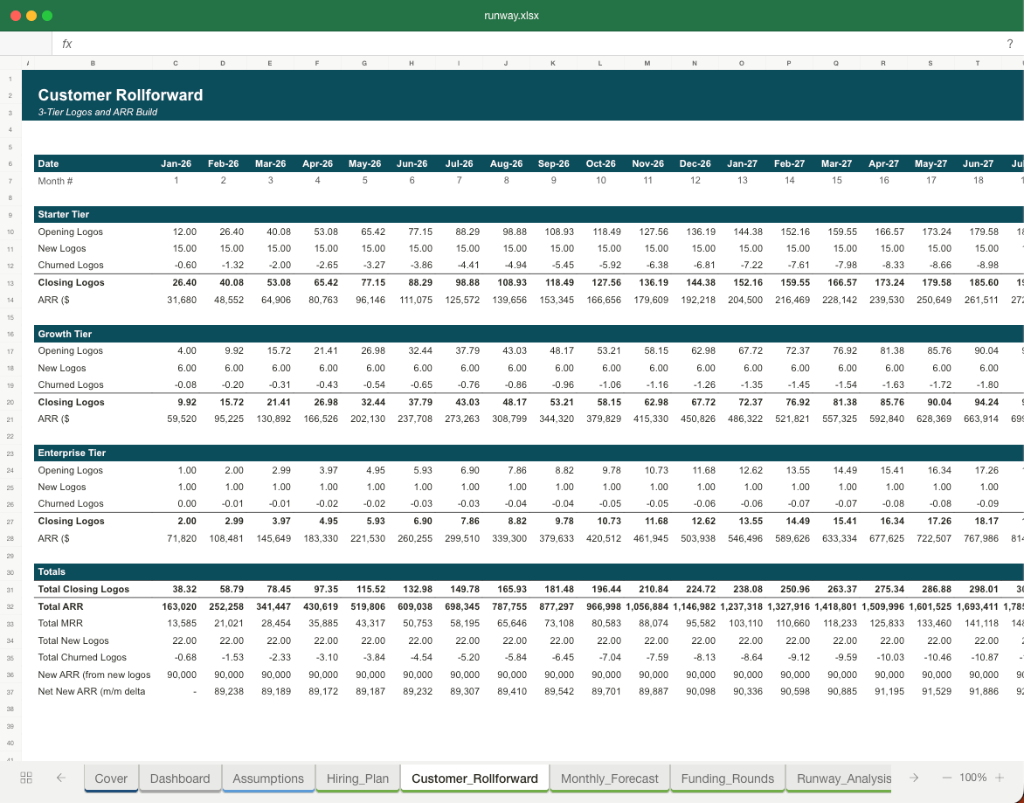
The forecast links revenue, gross margin, headcount, R&D, compute, and operating burn to transaction cash and runway. It includes sources and uses, redemption sensitivity, dilution, pro forma balance sheet, ownership, valuation multiples, and scenario-based financing requirements after the de-SPAC.
A turnkey financial model
Live formulas, no hardcoded values
Outputs are driven by live formulas, so the workbook updates from its assumptions instead of relying on hardcoded results.
All assumptions in one tab
Inputs are clearly marked in the Assumptions tab and separated from calculations, making it clear what to change and what to leave intact.
Statements always balancing
For integrated-statement models, the balance sheet, cash flow, and supporting schedules tie through properly.
Distinct schedules for clarity
Debt, working capital, taxes, and cash flow can get messy quickly. We group calculations in clear schedules, not across disconnected tabs.
No hidden macros or external links
There are no unexplained external workbook links or macros to undermine auditability or portability.
Changes flow through the model
Update a key driver and see the impact carry through the forecast, financing, and return outputs. We never use hardcoded numbers in formulas.
About Zapata AI SPAC
https:
How to build a detailed financial model for Zapata AI SPAC
A complete walkthrough of the business, drivers, and assumptions behind the downloadable Zapata AI SPAC model - distilled from its pitch deck and publicly available information.
Product & value proposition
- Two core products sold under the Orquestra® platform: Slide 4, 18, 19
- Zapata AI Prose™ - LLM compression and fine-tuning for enterprise text applications; compressed models require 300x fewer tokens to match uncompressed model performance Slide 13.
- Zapata AI Sense™ - Quantum-inspired generative models for complex numerical/mathematical problems (optimization, simulation, derivative pricing).
- Key performance claims (all from internal Zapata data):
- 8,400x speedup vs Monte Carlo simulation for multi-asset options pricing Slide 14.
- Up to 10x–1,000x speed-up on LLMs and other large models Slide 26.
- Compressed GPT2-XL outperforms GPT2-Small (same model size) in F1 accuracy Slide 13.
- GEO (Generator Enhanced Optimization) tied or outperformed state-of-the-art solvers in 71% of configurations for BMW manufacturing scheduling Slide 17.
- Platform: Orquestra® is hardware- and cloud-agnostic; supports CPU/GPU/TPU/QPU; integrates with AWS, Azure, GCP, IBM Cloud, and on-prem. Slide 18.
Market
- TAM: $1.3T (Generative AI Software and adjacencies by 2032) Slide 21 - source: Bloomberg Intelligence, June 2023.
- SOM: $366B by 2032 ($280B Generative AI Software + $86B Generative AI IT Services) Slide 21.
- McKinsey estimate: 63 Gen AI use cases across 16 business functions could deliver $2.6T–$4.4T annual P&L impact for enterprise Slide 21.
- Key verticals targeted: Automotive, Chemicals & Materials, Defense, Energy & Utilities, Finance, Logistics, Pharma Slide 23.
Revenue model
- Model: Recurring subscription; contracts recognized ratably. Slide 22.
- Contract length: 6+ month agreements with intent for multi-year subscriptions. Slide 22.
- Bundled offering: software license + scientific algorithm expertise (not pure SaaS; includes professional services component). Slide 22.
- Two sales motions: Slide 22
- Direct - C-level relationships, global sales force.
- Partner ecosystem - consulting firms (Top 5 Global Consultancy), cloud/software (Microsoft Azure, NVIDIA), hardware (IBM, IonQ), academia (MIT, University of Toronto).
- Land-and-expand: initial application foothold → expand ARPA (Average Revenue Per Account). Slide 22.
Traction & metrics
- Customers (named): Andretti Autosport, BASF, BBVA, bp, DARPA, top 5 food & bev company (unnamed), leading Clinical Research Organization (unnamed). Slides 4, 20.
- Partners (named): AWS, NVIDIA, IBM, IonQ, Microsoft Azure, top 5 global consultancy (unnamed). Slide 4.
- Total funding raised to date: $64M Slide 25.
- Headcount (as of Aug 28, 2023): 60 employees total; 41 scientists & engineers; 24 PhDs. Slide 25.
- IP: 50 US patent families & applications (100+ worldwide as of June 2023); ranked #5 most active in quantum-inspired AI patents (2020–2021, EPO). Slide 12.
- Revenue, ARR, growth rates, customer count, churn, NRR: Not in deck.
- DARPA: 2 awards to benchmark utility of quantum computing. Slide 20.
- Gartner Cool Vendor recognition. Slide 23.
Competition / moat
- Moat framing: Slides 9, 11, 12, 19
- Proprietary quantum-inspired generative AI algorithms (not reliant on quantum hardware - works on classical hardware today).
- Globally ranked IP portfolio: #5 in quantum-inspired AI patents 2020–2021; portfolio mix: Algorithms & Software 38%, Generative AI 30%, Differential Equations & Optimization 22%, Hardware Optimization 10%.
- Founded by Harvard quantum computing PhDs; 24 PhDs on staff; ~85K total academic citations (includes founder Alan Aspuru-Guzik's ~57.5K citations).
- Hardware/cloud agnostic platform vs. Big Tech's locked-in, one-size-fits-all LLMs.
- Named competitive positioning: positioned against OpenAI/ChatGPT-style general-purpose LLMs as "Industrial" specialist. Slide 9.
- Direct competitors: Not named in deck.
Team & funding ask / use of funds
Zapata AI leadership: Slide 25
- Christopher Savoie, Ph.D. - CEO; inventor of NLU behind Apple's Siri; formerly Nissan, Verizon.
- Yudong Cao, Ph.D. - CTO; 10 years AI & quantum; 30 patents; 2.4K+ citations; Harvard/Purdue.
- Mimi Flanagan - CFO; IHS Markit, Jenzabar, Qlik, Wyndham.
- Tim Stanley - VP Global Sales; 25+ years enterprise sales.
- Nicole Fitchpatric - General Counsel.
Andretti Acquisition Corp. (SPAC) leadership: Slide 5
- Bill Sandbrook (Chairman & Co-CEO): Former Chairman/CEO U.S. Concrete (25x market cap, 24x EBITDA, 35+ acquisitions).
- Michael Andretti (Co-CEO): IndyCar Champion, Founder/CEO Andretti Autosport.
- Matt Brown (President & CFO): Former CEO Rocky Mountain Industrials, former CFO Forterra, former CFO U.S. Concrete.
SPAC: Andretti Acquisition Corp. raised $230M oversubscribed SPAC IPO (NYSE: WNNR). Slide 5.
Transaction / Use of Funds: Slide 24
- Sources: Cash in Trust $50M + Bridge Financing $20M + Zapata Rollover $200M = $270M total.
- Uses: Cash to Balance Sheet $48M + Transaction Expenses $12M + Zapata Rollover $200M + Growth Capital $10M = $270M.
- $48M going to balance sheet (operating runway).
- $10M earmarked as "Growth Capital."
- Bridge: convertible notes at 15% discount to DeSPAC; up to $14.5M new + $5.5M existing Zapata convertible debt.
Investors (pre-SPAC): Ahren, Alumni Ventures, BASF, Bosch, Comcast Ventures, The Engine, Honeywell, ITOCHU, Merck, Pillar, Pitango, Prelude Ventures. $64M total raised. Slide 25.
Recommended financial model
- Archetype + why: SPAC / de-SPAC deal model - not an operating forecast model. This deck is a de-SPAC investor presentation, not a growth-stage pitch. The appropriate financial model is a SPAC / de-SPAC transaction model covering: (1) sources & uses and pro-forma capitalization, (2) dilution waterfall across redemption scenarios, (3) post-close balance sheet bridge, and (4) a lightweight operating scenario bridge (revenue ramp to illustrate when the company could hit key milestones). If the goal is an operating model for Zapata AI as a standalone company, a B2B SaaS / enterprise software ARR model is the secondary recommendation - but all revenue numbers would be assumed, as the deck discloses zero actual financials.
- Forecast horizon & granularity:
- Deal model: point-in-time (at close) + 1-year post-close sensitivity.
- Operating bridge (if built): Annual, 5 years (2024–2028), monthly for Year 1.
- Key drivers & assumptions:
*SPAC deal model:*
- SPAC trust size: $84.2M (7.9M shares × $10.66/share) Slide 24 note.
- Assumed redemption rate: 40% base case Slide 24 note → $50M cash in trust after redemption.
- Bridge financing: $20M convertible note at 15% discount to DeSPAC price Slide 24.
- Zapata pre-money equity value: $200M Slide 24.
- Pro-forma equity value: $331M Slide 24.
- Pro-forma enterprise value: $283M ($331M equity − $48M cash + $0 debt) Slide 24.
- Redemption sensitivity: 0%, 20%, 40%, 60%, 80%, 100% - varies cash to balance sheet and public shareholder %
- Founder share earnout / promote: 5.8M shares (17.5%) - no earnout condition disclosed; modeled as fully vested at close.
- Warrant dilution: excluded per slide note; model should add a warrant schedule.
*Operating bridge (supplementary):*
- Initial ARR / revenue: $0–$5M at close (pre-revenue scale; no figures disclosed); set as open variable.
- ARR growth rate: 100%+ YoY early years, decelerating to 50% by Year 3, given enterprise AI category growth and land-expand model.
- Average contract value (ACV): $500K–$2M based on enterprise C-level direct sales and 6+ month contracts; no data in deck.
- Gross margin: 60–70% - typical for enterprise AI/SaaS with significant scientific services component; lower than pure SaaS.
- R&D / S&M / G&A as % of revenue: heavy burn pre-revenue; model with headcount-based opex build (60 FTEs × avg fully-loaded cost).
- Cash runway: $48M balance sheet post-close Slide 24; 24–36 months at current burn, flex variable.
- Customer count: 7–10 active paying customers at close (based on named accounts).
- NRR / expansion: 110–130% - land-expand model stated; no data.
- Scenarios (Base / Bull / Bear - which variables flex):
- Bear: 80% redemption (less cash), slow revenue ramp ($3M ARR Year 1), high burn, Series A needed in 18 months.
- Base: 40% redemption ($48M post-close cash), $5M ARR Year 1, 24-month runway.
- Bull: 10% redemption (more cash), fast enterprise wins ($10M ARR Year 1), gross margins above 70%.
- Required sheets / outputs:
- Transaction Summary - Sources & Uses, Pro-Forma Cap Table (Zapata / Public / Founder / Bridge breakdown).
- Redemption Sensitivity Table - cash to balance sheet, pro-forma equity value, and ownership % by redemption level (0–100%, 10% steps).
- Dilution Schedule - warrants, bridge conversion at DeSPAC, PIK interest on bridge note.
- Pro-Forma Balance Sheet (at close).
- Operating Bridge (assumptions-driven) - ARR build, opex by function, EBITDA, cash burn, runway.
- Valuation Bridge - EV/ARR implied at various revenue scenarios.
Frequently asked
Is the Zapata AI SPAC financial model free?+
Yes. The Zapata AI SPAC model is a free Excel (.xlsx) download with live formulas. Sign up with your email and the workbook is yours to keep, review, and edit.
What's included in the model?+
A 5-year monthly forecast with P&L, cash flow and runway, valuation (exit multiple plus a DCF cross-check), MOIC/IRR returns, and unit economics, with live formulas throughout.
How was this model built?+
It was built from Zapata AI SPAC's pitch deck and publicly available information, then structured to investment-banking standards as a fully editable Excel model.
Can I change the assumptions?+
Yes. You can change assumptions and the live formulas will recalculate in the downloadable Excel model.
Have more financial modelling questions? Contact us

Created by ex-finance professionals
Hey, I’m Alex and I created Finamodel.
Over my years in the finance industry I kept building the same models over and over again. Same structure, same assumptions, different logo. So I started building frameworks to turn them into clean, reusable templates.
Every model here is one I’d actually use for a client, and I personally vet each one before it goes up.
I’m not an expert in every industry, but I’ve built enough models to know what belongs in one. And when something is completely foreign to me, I reach out to my network for experts to work on our models with us.
Having a template library on hand cuts a first build from hours to minutes.
Need help finding your model? You’ll find me in the Finamodel app!
Other AI/ML Startup Financial Models
Browse another startup in the same category.

AI Rudder
AI Rudder provides multi-lingual conversational AI for B2C customer engagement - automating outbound and inbound voice/chat interactions at scale.

Aisera
AI Service Experience platform that automates IT, HR, and customer service workflows via conversational AI and automation.

Amberscript
AI + human hybrid transcription and subtitling platform targeting B2B customers in Europe

Apheris
Privacy-preserving federated ML platform enabling enterprises to train AI on distributed data without sharing raw data.

Arcane
AI copilot for marketing teams that automates data analysis, reporting, and repeatable tasks via a chat interface and scheduled workflows.

Artisan
AI-powered "digital workers" (branded Artisans) that autonomously perform role-specific tasks - starting with outbound sales - and are delivered as SaaS subscriptions.

Artisan Series A
AI-native B2B SaaS platform consolidating the enterprise software stack with human-like "Artisan" AI employees that automate role-specific workflows

Bigblue
Tech-enabled e-commerce fulfillment platform for European D2C brands - "Amazon-standard" delivery without Amazon.