 Zevoy Financial Model
Fintech Startup Financials (Free Excel Download)
Expense management platform (Visa business cards + mobile app + web hub) for European SMEs, operating as an EMI licensed by the Finnish Financial Supervisory Authority (FIN-FSA).



professionals from Deloitte
Used by professionals from






About this model
Zevoy is a European SME expense-management platform combining Visa business cards, a mobile app, and a web hub. As a Finnish-regulated EMI, it gives finance teams a controlled way to manage employee spending and related workflows.
The company earns card interchange and is expected to charge a recurring SaaS fee, with a possible credit product adding future interest or fee income. Its documented go-to-market is outbound, making cold-call-to-demo-to-sign conversion a practical growth constraint.
The model should forecast sales outreach, demos, signed SMEs, subscription ARPU, card activation, and spend per active customer. Interchange, subscription ARR, and any credit economics should be separate schedules, with sales capacity, payment costs, and churn determining the path to scale.
A turnkey financial model
Live formulas, no hardcoded values
Outputs are driven by live formulas, so the workbook updates from its assumptions instead of relying on hardcoded results.
All assumptions in one tab
Inputs are clearly marked in the Assumptions tab and separated from calculations, making it clear what to change and what to leave intact.
Statements always balancing
For integrated-statement models, the balance sheet, cash flow, and supporting schedules tie through properly.
Distinct schedules for clarity
Debt, working capital, taxes, and cash flow can get messy quickly. We group calculations in clear schedules, not across disconnected tabs.
No hidden macros or external links
There are no unexplained external workbook links or macros to undermine auditability or portability.
Changes flow through the model
Update a key driver and see the impact carry through the forecast, financing, and return outputs. We never use hardcoded numbers in formulas.
About Zevoy
zevoy.com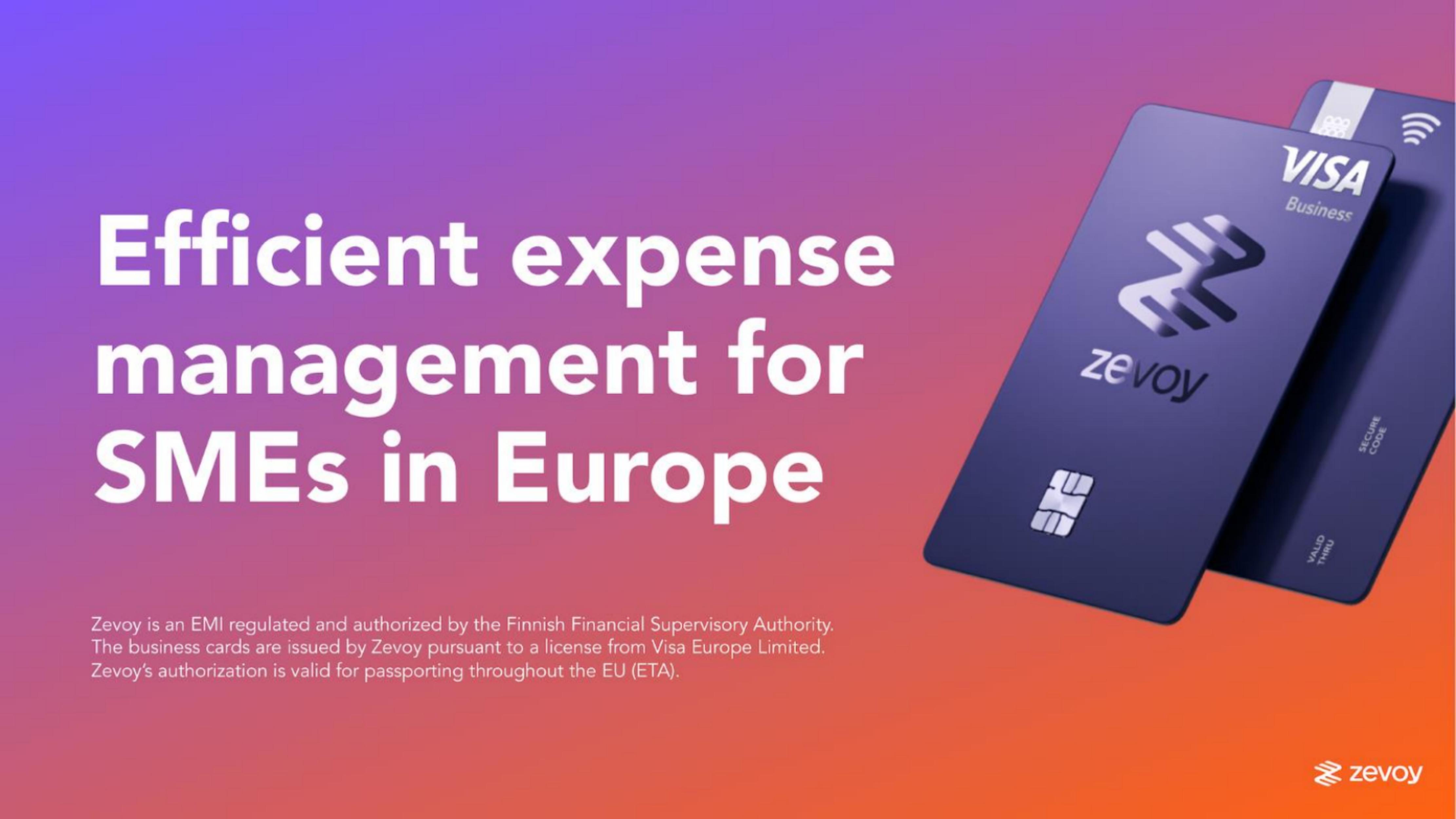
How to build a detailed financial model for Zevoy
A complete walkthrough of the business, drivers, and assumptions behind the downloadable Zevoy model - distilled from its pitch deck and publicly available information.
Product & value proposition
- All-in-one expense management: instant issuing of physical and/or virtual Visa cards (credit or prepaid), Apple Pay & Google Pay enabled.
- Mobile app: receipt scanning, card management, real-time expense viewing.
- Web hub: company-level expense oversight, card limit management, accounting export.
- Positioning: faster and cheaper to launch than competitors (launched in <1 year on €1M vs. peers spending 2+ years); owns Visa licence and FIN-FSA EMI authorisation directly.
Market
- TAM: €170B expense management market (sourced from Soldo).
- Addressable customers: 25M SMEs in Europe with turnover €0.2M–€100M (Eurostat).
- Current penetration: ~100,000 companies in Europe using similar services total across all players.
Revenue model
- Card interchange: Visa card transactions generate interchange revenue for Zevoy as EMI card issuer.
- SaaS subscription fee:
- Credit product: Deck mentions "credit or prepaid" card options; credit implies interest/fee income. Details not disclosed.
- Sales channel: Outbound only - cold call → demo → signing funnel. 1/10 cold call conversion rate.
- No pricing tiers, ARPU, or monthly fee schedule shown.
Traction & metrics
- 100+ signed new customers per month (as of late 2021).
- 1/10 cold call → demo → signing conversion rate.
- 80% of customers have A+ credit ratings or better.
- 2 markets live: Finland and Sweden.
- Customer growth chart (slide 8): exponential curve Apr 2021 → Dec 2021; no Y-axis labels or absolute customer count shown on chart.
- Launched in <1 year, spent €1M to reach launch.
- Total customer count (cumulative): Not explicitly stated (implied by 100+/month run-rate and ~9-month operating period).
Competition / moat
- Direct competitors: Pleo, Soldo, Spendesk, Payhawk, Moss, Yokoy - all concentrated in Western Europe (UK, France, DACH).
- Moat claims:
- Owns Visa licence and FIN-FSA EMI authorisation directly (most peers rely on third-party BIN sponsors).
- EU passporting across full EEA - no country-by-country re-licensing needed.
- Geographic white-space: targeting underserved Nordics + CEE where competitor density is low ("Wolt route").
- Credit quality filter: 80% A+ customers → lower loss rates than open-market approach.
- Cost-efficient launch: €1M vs. competitors' multi-year, higher-spend launches.
Team & funding ask / use of funds
- CEO Christoffer Rosqvist: 20+ years cards/payment/retail banking.
- CTO Joakim Lundborg: 10+ years fintech CTO experience (ex-Wrapp/Meniga).
- CMSO Ron Lindqvist: 10 years high-growth cloud/B2B sales.
- CPO Mikko Kiviniemi: 18+ years digital product and brand.
- CFO Jonas Strahl: 15 years payment value chain, programming through financial/legal administration.
- COO Valtteri Hasa: 25+ years risk, operations, compliance (banks and consulting).
- Advisor Aage Reerslev: serial fintech/internet entrepreneur, strategy.
- Team size: 35+ FTE across Helsinki, Stockholm, and Skopje.
- Prior spend: €1M to launch.
Recommended financial model
Archetype + why: B2B SaaS + interchange revenue model (dual revenue stream). Zevoy earns (a) a recurring subscription/seat fee per SME customer and (b) interchange on card spend volume. The primary growth driver is new customer acquisition via outbound sales; card volume is a secondary lever. This is closest to a B2B SaaS ARR model with an embedded payments revenue layer - similar to Pleo/Spendesk comp set.
Forecast horizon & granularity:
- 3 years monthly (Year 1–2) → quarterly (Year 3).
- Monthly is essential given the outbound sales funnel cadence (100+ customers/month run-rate) and the need to model SDR headcount, ramp, and market-by-market expansion.
Key drivers & assumptions:
*Customer acquisition*
- Monthly new customer signings: 100+; assume 100 in current month, growing at
- Cold call → signing conversion: 1/10
- SDR headcount to calls ratio:
- Customer churn:
*Markets*
- Markets live at model start: 2 (Finland, Sweden)
- New market launches per year:
- Revenue per market scales with SME population density:
*Revenue*
- SaaS subscription fee:
- Cards per customer:
- Monthly card spend per customer:
- Interchange rate:
- Credit product interest/fee:
*Unit economics*
- Gross margin on SaaS:
- Gross margin on interchange:
- Blended gross margin:
- CAC:
- LTV:
- Payback:
*Cost structure*
- Headcount: 35+ FTE at model start; assume scaling with market expansion
- Compliance/regulatory:
- Card issuance / Visa programme fees:
Scenarios (Base / Bull / Bear - which variables flex):
- Bear: customer growth slows to 5% MoM; 1 new market/year; churn at 2.5%; SaaS price discounted to €79/company
- Base: 100 new customers/month growing 8–12% MoM; 2 new markets/year; churn 1.5%; SaaS at €99/company
- Bull: outbound scales faster (15%+ MoM) via headcount; 3 new markets/year; credit product layer adds 20% revenue upside; churn 0.8%
Required sheets / outputs:
- Assumptions - all drivers centralized with scenario toggle (Base/Bull/Bear)
- Customer cohort waterfall - monthly new, churned, active customers by market
- Revenue build - SaaS MRR/ARR + interchange GMV; blended
- P&L - revenue, COGS (interchange processing, card issuance), gross profit, S&M (SDR headcount + outbound costs), R&D, G&A (compliance, legal, FIN-FSA fees), EBITDA
- Headcount plan - by function, by market
- Cash flow - operating CF + funding runway; flag when next raise is needed
- Unit economics summary - CAC, LTV, LTV:CAC, payback per cohort
- Market expansion tracker - country-by-country launch timeline and contribution
Frequently asked
Is the Zevoy financial model free?+
Yes. The Zevoy model is a free Excel (.xlsx) download with live formulas. Sign up with your email and the workbook is yours to keep, review, and edit.
What's included in the model?+
A 5-year monthly forecast with P&L, cash flow and runway, valuation (exit multiple plus a DCF cross-check), MOIC/IRR returns, and unit economics, with live formulas throughout.
How was this model built?+
It was built from Zevoy's pitch deck and publicly available information, then structured to investment-banking standards as a fully editable Excel model.
Can I change the assumptions?+
Yes. You can change assumptions and the live formulas will recalculate in the downloadable Excel model.
Have more financial modelling questions? Contact us

Created by ex-finance professionals
Hey, I’m Alex and I created Finamodel.
Over my years in the finance industry I kept building the same models over and over again. Same structure, same assumptions, different logo. So I started building frameworks to turn them into clean, reusable templates.
Every model here is one I’d actually use for a client, and I personally vet each one before it goes up.
I’m not an expert in every industry, but I’ve built enough models to know what belongs in one. And when something is completely foreign to me, I reach out to my network for experts to work on our models with us.
Having a template library on hand cuts a first build from hours to minutes.
Need help finding your model? You’ll find me in the Finamodel app!
Other Fintech Startup Financial Models
Browse another startup in the same category.
Acin
SaaS and data subscription network for operational risk management at Tier 1 financial institutions

Ageras Group
B2B SME ecosystem - marketplace connecting SMEs with accountants + cloud accounting/payroll software + embedded financial services (lending, factoring, banking)

Airbase
Unified non-payroll spend management platform (corporate cards, AP/bill pay, expense reimbursement, approval workflows) for mid-market companies.

Altruist
Vertically integrated all-in-one platform for registered investment advisors (RIAs) - combining custodial, portfolio management, practice management, and client acquisition tools.
Amenitiz
All-in-one hotel management SaaS platform ("Shopify for hotels") for independent hoteliers - PMS, booking engine, channel manager, website builder, payments, and AI-driven revenue management.

Anrok
SaaS sales tax compliance platform - nexus monitoring, calculation, registration, filing, and remittance - built specifically for SaaS companies.
Arrival
Arrival is an EV manufacturer of commercial vans and buses using proprietary Microfactories and vertically integrated components, going public via SPAC merger with CIIG Merger Corp.

AtoB
AtoB is building financial infrastructure for commercial fleets, starting with a no-fee Visa fleet card for fuel and expanding into payroll, BNPL, and international.


