 Aura Financial Model
Consumer/DTC Startup Financials (Free Excel Download)
All-in-one consumer "intelligent safety" subscription replacing fragmented point solutions for identity, device, WiFi, social, assets, and privacy protection.



professionals from Deloitte
Used by professionals from






About this model
Aura is a consumer intelligent-safety subscription that bundles identity, device, WiFi, social, asset, and privacy protection in one app. It replaces several fragmented point solutions with a single login, bill, and protection experience.
The direct-to-consumer plan costs $19.85 per month, materially below the cited cost of purchasing comparable tools separately. Its value proposition is simplification as well as a broad set of digital-protection benefits.
The model is consumer subscription ARR. Members, paid conversion, monthly price, family-plan or upsell potential, churn, and retention determine revenue. Identity-service costs, acquisition, claims or support, and subscriber engagement drive margin.
A turnkey financial model
Live formulas, no hardcoded values
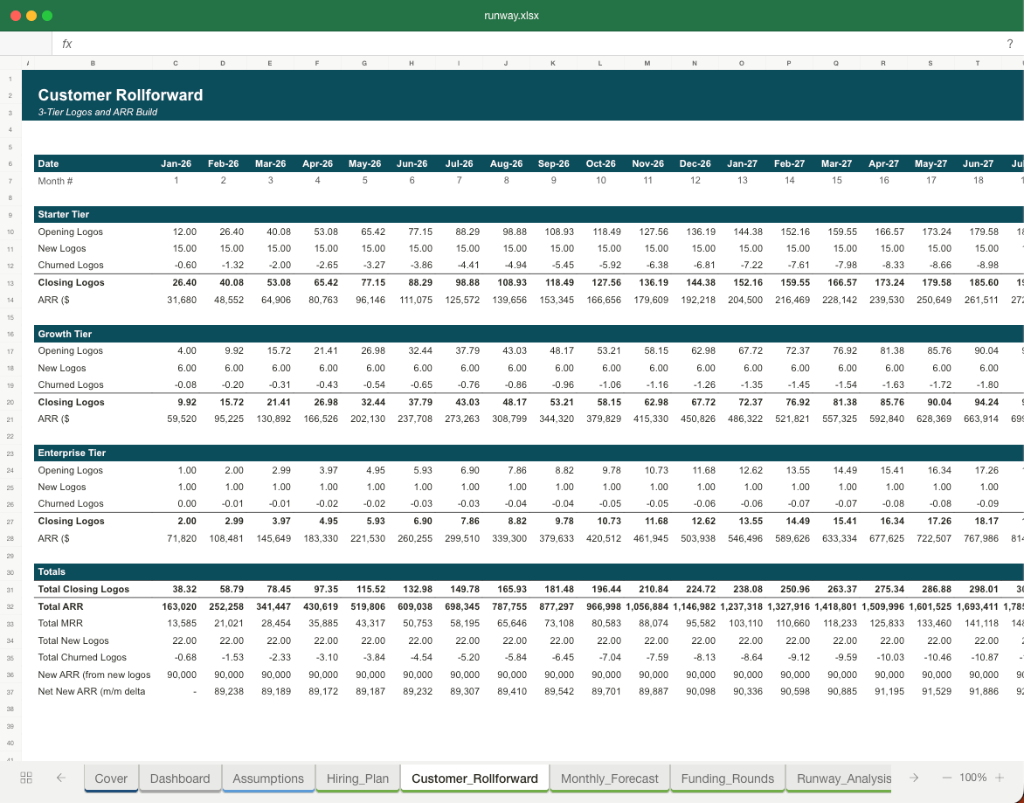
Outputs are driven by live formulas, so the workbook updates from its assumptions instead of relying on hardcoded results.
All assumptions in one tab
Inputs are clearly marked in the Assumptions tab and separated from calculations, making it clear what to change and what to leave intact.
Statements always balancing
For integrated-statement models, the balance sheet, cash flow, and supporting schedules tie through properly.
Distinct schedules for clarity
Debt, working capital, taxes, and cash flow can get messy quickly. We group calculations in clear schedules, not across disconnected tabs.
No hidden macros or external links
There are no unexplained external workbook links or macros to undermine auditability or portability.
Changes flow through the model
Update a key driver and see the impact carry through the forecast, financing, and return outputs. We never use hardcoded numbers in formulas.
About Aura
aura.com
How to build a detailed financial model for Aura
A complete walkthrough of the business, drivers, and assumptions behind the downloadable Aura model - distilled from its pitch deck and publicly available information.
Product & value proposition
Aura bundles six protection categories - Identity, Device (antivirus/anti-malware), WiFi/VPN, Social (cyberbullying, social image, criminal record), Assets (home title, bank account, 401k), and Privacy (data removal, robocall blocking) - into a single app, login, and bill at $19.85/month. Competitors offering equivalent coverage piecemeal cost $76.90/month across 6 products, 6 bills, 6 logins. The product runs on web, mobile, desktop, and home network. The tech stack includes a proprietary ML/AI personalization engine fed by a data lake spanning VPN traffic, dark web, credit feeds, browsing data, DNS, public records, and IoT.
Market
- TAM stated as $100B opportunity; no methodology or breakdown shown.
- Digital crime financial losses (US consumers): $0.9B (2017) → $1.5B (2018) → $1.9B (2019) → $3.3B (2020E); source: U.S. FTC 2020 Consumer Sentinel Report.
- Home burglary losses for comparison: $3.4B (2017), $3.4B (2018), $3.0B (2019), $2.7B (2020E); digital crime losses surpassed home burglary by 2020.
Revenue model
- Model: Monthly subscription, direct-to-consumer.
- Price: $19.85/month (all-in plan). No annual pricing, tiered plans, or family plan pricing shown in deck beyond this single price point.
- Value anchor vs. alternatives: $76.90/month for 6 equivalent standalone products; Aura = ~74% discount.
- Channels: App (mobile, web, desktop); no channel partner / affiliate / employer channel disclosed.
Competition / moat
- Named competitors (fragmented): CyberScout, InfoArmor, ID Watchdog, LifeLock, MyCleanPC, Malwarebytes, PC Matic, Private Internet Access, NordVPN, Norton, ExpressVPN, Bark, TruthFinder, Title Lock, Secure Title Lock, ManagerUrID, DeleteMe, OneRep.
- Moat claims: Proprietary ML/AI personalization engine; bundled data lake from own product usage (VPN traffic, credit feeds, dark web, etc.) creating data flywheel; automation reduces consumer decision-making burden; proactive vs. reactive posture.
- Positioning: "Intelligent Safety" category - distinct from "security/guard/shield" fear-based language of competitors.
Recommended financial model
- Archetype + why: Consumer subscription SaaS (subscriber-based ARR model). Revenue is purely recurring monthly subscription at a fixed price point; churn, subscriber growth, and CAC payback are the core value drivers. A 3-statement model sits underneath to capture the cost structure (data/infra, sales & marketing, R&D, G&A).
- Forecast horizon & granularity: 5-year annual (Year 1–5), with Year 1 monthly for cash runway visibility. Monthly granularity important given subscription nature and likely high early CAC.
- Key drivers & assumptions:
| Driver | Value |
|---|---|
| Monthly subscription price | $19.85 |
| Competitor bundle price (context) | $76.90 |
| Monthly subscriber growth rate | 8–15% MoM early, tapering |
| Monthly churn rate | 2.0–3.5% |
| Blended CAC | $50–$120 |
| LTV (= ARPU / churn) | ~$567–$993 at 2–3.5% churn |
| LTV:CAC ratio | 5–8x target |
| Gross margin | 60–70% |
| S&M as % of revenue (early) | 40–60% |
| R&D as % of revenue | 15–25% |
| G&A as % of revenue | 8–12% |
| Annual digital crime loss growth (US market context) | ~54% CAGR 2017–2020 |
- Scenarios (Base / Bull / Bear - which variables flex):
- *Base:* 10% MoM subscriber growth tapering to 3% by Y5; 2.5% churn; CAC $80.
- *Bull:* 15% MoM growth tapering to 5%; 1.8% churn; CAC $60 (viral/referral upside, employer channel).
- *Bear:* 6% MoM growth tapering to 2%; 4% churn; CAC $130 (paid-only, competitive market).
- Primary flex variables: subscriber growth rate, churn, CAC.
- Required sheets / outputs:
- Assumptions - all drivers, scenarios toggle.
- Subscriber Model - beginning subscribers, new adds, churned, ending; MoM and YoY.
- Revenue Build - subscribers × $19.85 × 12; MRR and ARR.
- P&L (Income Statement) - Revenue, COGS, Gross Profit, S&M, R&D, G&A, EBITDA, Net Income.
- Unit Economics - CAC, LTV, LTV:CAC, payback period, cohort contribution margin.
- Cash Flow - Operating CF, capex (minimal), free cash flow, cumulative burn.
- Balance Sheet - simplified (cash, deferred revenue, equity).
- Dashboard - MRR, ARR, subscriber count, churn rate, LTV:CAC, runway.
Frequently asked
Is the Aura financial model free?+
Yes. The Aura model is a free Excel (.xlsx) download with live formulas. Sign up with your email and the workbook is yours to keep, review, and edit.
What's included in the model?+
A 5-year monthly forecast with P&L, cash flow and runway, valuation (exit multiple plus a DCF cross-check), MOIC/IRR returns, and unit economics, with live formulas throughout.
How was this model built?+
It was built from Aura's pitch deck and publicly available information, then structured to investment-banking standards as a fully editable Excel model.
Can I change the assumptions?+
Yes. You can change assumptions and the live formulas will recalculate in the downloadable Excel model.
Have more financial modelling questions? Contact us

Created by ex-finance professionals
Hey, I’m Alex and I created Finamodel.
Over my years in the finance industry I kept building the same models over and over again. Same structure, same assumptions, different logo. So I started building frameworks to turn them into clean, reusable templates.
Every model here is one I’d actually use for a client, and I personally vet each one before it goes up.
I’m not an expert in every industry, but I’ve built enough models to know what belongs in one. And when something is completely foreign to me, I reach out to my network for experts to work on our models with us.
Having a template library on hand cuts a first build from hours to minutes.
Need help finding your model? You’ll find me in the Finamodel app!
Other Consumer/DTC Startup Financial Models
Browse another startup in the same category.
Accel Club
Accel Club acquires Amazon third-party (FBA) seller businesses at 3–4x EV/EBITDA and scales them through operational integration, then exits at higher consumer/D2C multiples.
Afrocenchix
D2C brand selling natural, vegan-certified hair-care products for afro and curly hair.

Amperity
Enterprise Customer Data Platform (CDP) that unifies first-, second-, and third-party customer data across siloed systems to power personalization, analytics, and marketing activation.

AnyRoad
Enterprise SaaS platform for managing, measuring, and optimising branded experiential marketing.
Attentive
B2B SMS / mobile marketing SaaS for e-commerce and retail brands.

Belgian Boys
Belgian-inspired premium specialty food brand selling cookies, refrigerated cheesecakes, frozen waffles/crepes, and snacks through US retail and DTC channels.
Bespoken Spirits
Technology company that replaces barrel aging with a proprietary ACTivation process to produce premium, customizable spirits in days rather than decades.
Chamberlain Coffee
Gen Z-focused coffee and matcha CPG brand, founded by influencer Emma Chamberlain, selling across DTC and retail channels.