 Belgian Boys Financial Model
Consumer/DTC Startup Financials (Free Excel Download)
Belgian-inspired premium specialty food brand selling cookies, refrigerated cheesecakes, frozen waffles/crepes, and snacks through US retail and DTC channels.



professionals from Deloitte
Used by professionals from






About this model
Belgian Boys is a premium specialty-food brand selling cookies, cheesecakes, waffles, crepes, and snacks. Its playful brand and indulgent-but-clean ingredient positioning target modern consumers across several eating occasions.
The company sells through major grocery, mass, and club retailers while also using DTC and online partners. It had 20 SKUs, more than 3,000 retail shelf locations, and six million treats consumed in 2020.
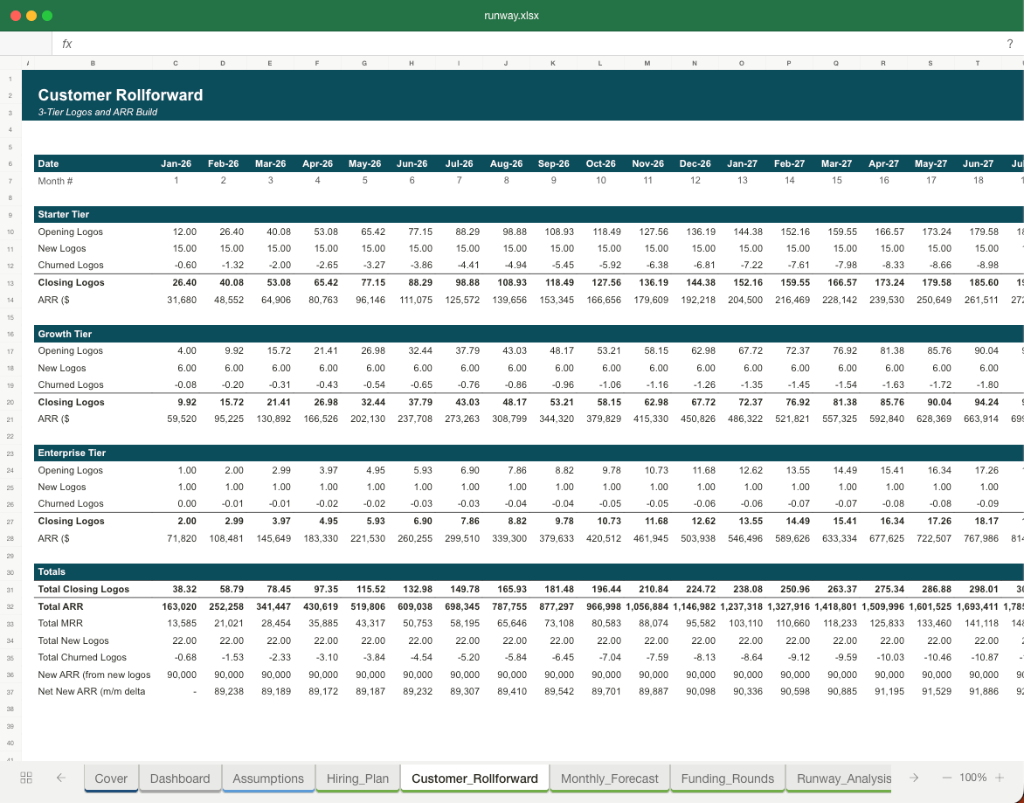
The model is CPG revenue by channel. Retail doors, velocity, SKUs, wholesale price, DTC orders, COGS, trade spend, and distribution costs build revenue and margin. New-product launches and retailer expansion determine growth.
A turnkey financial model
Live formulas, no hardcoded values
Outputs are driven by live formulas, so the workbook updates from its assumptions instead of relying on hardcoded results.
All assumptions in one tab
Inputs are clearly marked in the Assumptions tab and separated from calculations, making it clear what to change and what to leave intact.
Statements always balancing
For integrated-statement models, the balance sheet, cash flow, and supporting schedules tie through properly.
Distinct schedules for clarity
Debt, working capital, taxes, and cash flow can get messy quickly. We group calculations in clear schedules, not across disconnected tabs.
No hidden macros or external links
There are no unexplained external workbook links or macros to undermine auditability or portability.
Changes flow through the model
Update a key driver and see the impact carry through the forecast, financing, and return outputs. We never use hardcoded numbers in formulas.
About Belgian Boys
belgianboys.com
How to build a detailed financial model for Belgian Boys
A complete walkthrough of the business, drivers, and assumptions behind the downloadable Belgian Boys model - distilled from its pitch deck and publicly available information.
Product & value proposition
- Four product categories: Cookies, Refrigerated (cheesecakes), Frozen (waffles, crepes, brookies), Snacks/impulse.
- SKU count: 20 SKUs across 4 categories as of 2020.
- Positioning: Premium permissible indulgence - real ingredients (butter, eggs, flour, vanilla, chocolate), no artificial flavors/colors/preservatives, Non-GMO, Kosher Certified.
- Bold, playful branding targeting millennials and modern moms.
- Multiple daypart coverage: breakfast (crepes, mini pancakes), snack (individually-wrapped cookies), dessert (cheesecakes, brookies).
Market
- Specialty food & bev market: $158.4B in 2019, +10.7% vs 2017; specialty = 20.5% of all US food & beverage retail sales in 2019.
- Specialty segment sizes Belgian Boys targets:
- Cookies (specialty): $1.5B
- Refrigerated (specialty): $1.7B
- Frozen (specialty): $2.7B
- Combined addressable specialty segments: ~$5.9B
- No SAM or SOM figures provided. No category growth rates (CAGR) provided.
Revenue model
- Wholesale/retail: sells into grocery (Whole Foods, Kroger, Walmart, Target, Costco, Sam's Club, Albertsons, Safeway, Harris Teeter, Ralphs, etc.) and mass/club channels.
- E-commerce/DTC: Amazon, DoorDash, Faire, Boxed, GoPuff, SnackMagic, SnackNation.
- Brand/hospitality partnerships: JetBlue, Drybar, Popbar, UrbanStems, Nets (NBA), La Colombe, Happy Socks. - likely sampling/co-marketing deals, not pure revenue lines.
- In-store strategy: merchandise across multiple store sections (cookies aisle + frozen + fresh/refrigerated + impulse) to maximize velocity per retailer.
Traction & metrics
- 6M+ treats indulged (2020)
- 3,000+ retail shelf locations (2020)
- 20 SKUs across 4 categories (2020)
- 2x team growth (year not specified)
- 18M+ smiling customers (cumulative or annual unclear)
- >80K treats donated to local communities
- Store count: 3,000 stores in 2020 → 5,000 stores in 2021 (target/actual unspecified)
- Inc. 5000 ranked #1700
- No revenue, gross margin, or net income figures disclosed.
Competition / moat
- Deck does not name specific competitors.
- Implied competitive positioning: whitespace in specialty/premium sub-segments of cookies, refrigerated desserts, and frozen; differentiated by European provenance, bold branding, and clean ingredients.
- Moat claimed: brand identity ("dynamic branding & messaging"), multi-category presence driving retail velocity, omni-channel distribution breadth, social mission (donations, community partnerships).
Team & funding ask / use of funds
- Founders nicknamed "Skinny & Chubby" - Belgian-born, moved to US, founded company around importing Belgian treats.
- Company is Women Owned certified.
- Team doubled in size (period not specified).
Recommended financial model
- Archetype + why: DTC/Wholesale CPG revenue model with SKU-level P&L. Belgian Boys is a multi-channel specialty food brand with retail distribution as the primary channel. The right model is a CPG wholesale + DTC hybrid, built around store count × velocity × price, with a separate DTC/e-commerce revenue stream. Not a SaaS, marketplace, or M&A model.
- Forecast horizon & granularity: 3 years (2021–2023), monthly for Year 1, quarterly for Years 2–3. Retail channel lags require monthly build to capture shelf resets and new distribution waves.
- Key drivers & assumptions:
*Retail channel:*
- Store count: 3,000 (2020) → 5,000 (2021); ~6,500 in 2022, ~8,000 in 2023 - gradual door expansion into mid-tier grocery chains.
- Average velocity (units/store/week): ~2–4 units/SKU/week - standard specialty food velocity for premium brands; validate against actual Nielsen/SPINS data.
- Active SKUs per store: 3–5 SKUs average across categories; not all 20 SKUs distributed everywhere.
- Wholesale price per unit: ~$3.50–$5.00 (retailers typically mark up 35–50%; MSRP implied $6–$10 for premium specialty snacks).
- Trade spend / slotting / promotions: 15–20% of gross wholesale revenue - typical for specialty retail.
*DTC / e-commerce channel:*
- DTC % of revenue: 15–25% - growing but secondary to retail for CPG at this stage.
- AOV (average order value): $35–$50 for direct e-commerce bundles.
- Repeat purchase rate: 25–35% within 90 days.
*Gross margin:*
- COGS / gross margin: 30–40% gross margin - typical for specialty food with premium ingredients and co-manufacturing; lower end if Costco/Sam's Club volume is material (club channel pricing pressure).
- COGS components: ingredients, co-manufacturing, packaging, inbound freight.
*Operating costs:*
- Headcount: team doubled; ~10–20 employees at time of deck; model headcount by function.
- Marketing / brand: 8–12% of net revenue (brand partnerships + digital).
- Broker/distributor commissions: 5–8% of retail channel revenue.
- Logistics/warehousing: 8–12% of revenue (cold-chain SKUs add cost).
- Scenarios (Base / Bull / Bear - which variables flex):
- Bear: Store expansion stalls at ~4,000 doors by 2023; velocity flat; gross margin compresses to 28% (input cost inflation).
- Base: 8,000 doors by 2023; steady velocity improvement; 35% gross margin.
- Bull: Rapid door expansion (10,000+ doors) + DTC breakout + club channel velocity; gross margin holds at 38–40% through volume leverage.
- Key flex variables: store count, velocity/door, SKU count per store, gross margin, DTC mix.
- Required sheets / outputs:
- Assumptions - all drivers centralized.
- Revenue build - retail (store count × active SKUs × velocity × wholesale price) + DTC (orders × AOV).
- COGS & gross margin - by channel.
- Operating P&L - SG&A, marketing, logistics, headcount.
- Working capital - inventory days (specialty frozen = long lead), AR (retailer payment terms ~30–60 days), AP.
- Cash flow & funding need - given no revenue disclosed and stated investment round, size the runway gap.
- Scenario toggle - Bear / Base / Bull.
- Dashboard - KPI summary (store count, revenue, gross margin %, EBITDA %).
Frequently asked
Is the Belgian Boys financial model free?+
Yes. The Belgian Boys model is a free Excel (.xlsx) download with live formulas. Sign up with your email and the workbook is yours to keep, review, and edit.
What's included in the model?+
A 5-year monthly forecast with P&L, cash flow and runway, valuation (exit multiple plus a DCF cross-check), MOIC/IRR returns, and unit economics, with live formulas throughout.
How was this model built?+
It was built from Belgian Boys's pitch deck and publicly available information, then structured to investment-banking standards as a fully editable Excel model.
Can I change the assumptions?+
Yes. You can change assumptions and the live formulas will recalculate in the downloadable Excel model.
Have more financial modelling questions? Contact us

Created by ex-finance professionals
Hey, I’m Alex and I created Finamodel.
Over my years in the finance industry I kept building the same models over and over again. Same structure, same assumptions, different logo. So I started building frameworks to turn them into clean, reusable templates.
Every model here is one I’d actually use for a client, and I personally vet each one before it goes up.
I’m not an expert in every industry, but I’ve built enough models to know what belongs in one. And when something is completely foreign to me, I reach out to my network for experts to work on our models with us.
Having a template library on hand cuts a first build from hours to minutes.
Need help finding your model? You’ll find me in the Finamodel app!
Other Consumer/DTC Startup Financial Models
Browse another startup in the same category.
Accel Club
Accel Club acquires Amazon third-party (FBA) seller businesses at 3–4x EV/EBITDA and scales them through operational integration, then exits at higher consumer/D2C multiples.
Afrocenchix
D2C brand selling natural, vegan-certified hair-care products for afro and curly hair.

Amperity
Enterprise Customer Data Platform (CDP) that unifies first-, second-, and third-party customer data across siloed systems to power personalization, analytics, and marketing activation.

AnyRoad
Enterprise SaaS platform for managing, measuring, and optimising branded experiential marketing.
Attentive
B2B SMS / mobile marketing SaaS for e-commerce and retail brands.

Aura
All-in-one consumer "intelligent safety" subscription replacing fragmented point solutions for identity, device, WiFi, social, assets, and privacy protection.
Bespoken Spirits
Technology company that replaces barrel aging with a proprietary ACTivation process to produce premium, customizable spirits in days rather than decades.
Chamberlain Coffee
Gen Z-focused coffee and matcha CPG brand, founded by influencer Emma Chamberlain, selling across DTC and retail channels.