CSCMR Surgery Financial Model
Health-tech Startup Financials (Free Excel Download)
CMR Surgical builds Versius, a portable modular robotic surgery system designed to make minimally-invasive keyhole surgery accessible to more patients worldwide.



professionals from Deloitte
Used by professionals from






About this model
CMR Surgical builds Versius, a portable modular robotic-surgery system intended to make minimally invasive procedures more accessible. It combines capital equipment with a broader clinical and data platform for hospitals.
System sales or placements create the installed base, while instruments and consumables generate recurring revenue per procedure. Versius Connect and Insight add an emerging software and data layer around the surgical workflow.
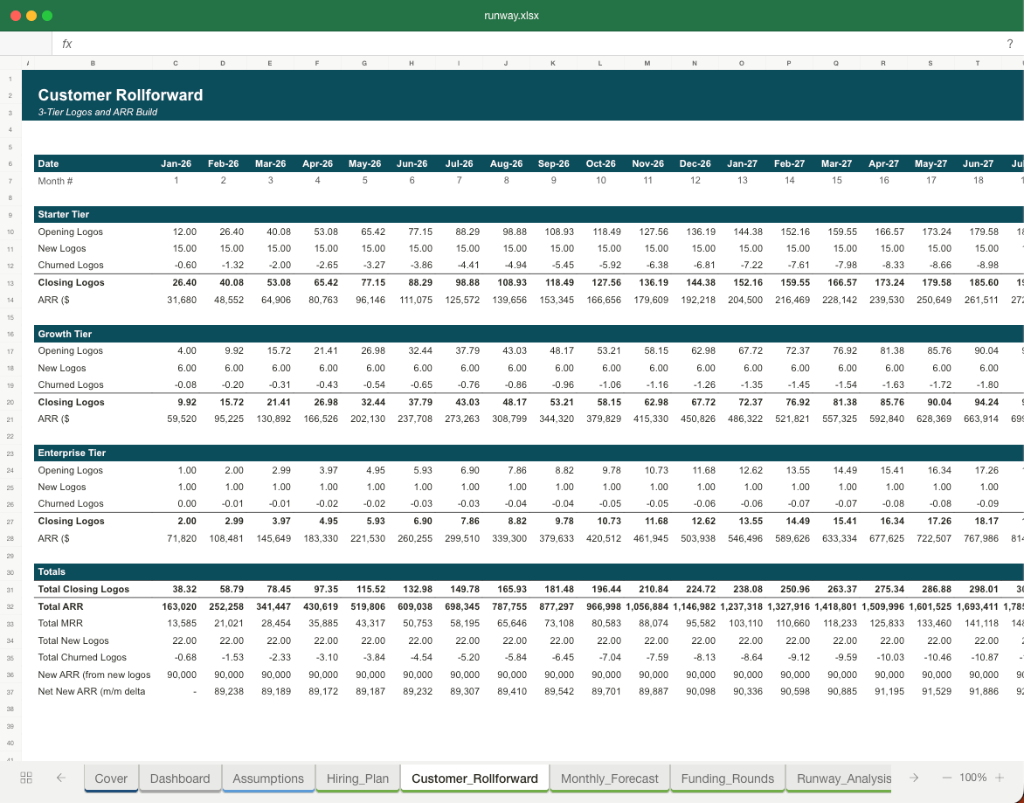
The model should forecast hospital placements, systems sold, procedures per installed system, instrument revenue per procedure, and service contracts. Manufacturing, sales cycles, regulatory approvals, depreciation or leasing, and clinical-support costs should be separately scheduled.
A turnkey financial model
Live formulas, no hardcoded values
Outputs are driven by live formulas, so the workbook updates from its assumptions instead of relying on hardcoded results.
All assumptions in one tab
Inputs are clearly marked in the Assumptions tab and separated from calculations, making it clear what to change and what to leave intact.
Statements always balancing
For integrated-statement models, the balance sheet, cash flow, and supporting schedules tie through properly.
Distinct schedules for clarity
Debt, working capital, taxes, and cash flow can get messy quickly. We group calculations in clear schedules, not across disconnected tabs.
No hidden macros or external links
There are no unexplained external workbook links or macros to undermine auditability or portability.
Changes flow through the model
Update a key driver and see the impact carry through the forecast, financing, and return outputs. We never use hardcoded numbers in formulas.
About CMR Surgery
cmrsurgery.com
How to build a detailed financial model for CMR Surgery
A complete walkthrough of the business, drivers, and assumptions behind the downloadable CMR Surgery model - distilled from its pitch deck and publicly available information.
Product & value proposition
- Versius: portable, modular, data-driven surgical robot; biomimics the human arm; fits into "virtually any operating room".
- Targets minimally-assisted surgery (MAS) / keyhole surgery; 3D vision, enhanced instrument range of motion, access to previously inaccessible body areas.
- Not a one-off sale - framed as a long-term hospital partnership including training programme.
- Digital ecosystem layered on top: Versius Connect (surgeon app), CMR Surgical Registry (clinical data), Versius Trainer, Versius Insight (hospital dashboards), predictive maintenance.
- IP moat: 135 patent families, 731 filings, 118 granted patents.
Market
- Global surgical procedures (total, all modalities): 55mm (2018) → 58mm (2020) → 66mm (2025) → 75mm (2030); CAGR 2018–2030: +2.6%.
- Robotic procedures CAGR 2018–2030: 20.4%; "robotic procedures expected to grow at c.20% a year".
- Open surgery 2018–2030 CAGR: 1.2%; manual keyhole CAGR: 2.1%.
- Market sizing drivers: ageing population, lifestyle disease prevalence, emerging market demand, growing national healthcare spending, awareness of advanced technologies.
- Only ~50% of surgical patients currently receive keyhole surgery.
- No explicit TAM/SAM/SOM dollar figure stated.
Revenue model
- Capital equipment: sale or placement of Versius robotic systems to hospitals.
- Instruments / consumables: per-procedure instrument usage (implied by modular system and "long-term partnership" framing); recurring revenue stream per installed system.
- Software / data services: Versius Connect, Versius Insight dashboards, registry - digital revenue layer (pricing/monetisation not specified in deck).
- Training / education: professional education and field service bundled into partnership model.
- Direct hospital sales channel (implied by partnership language); no mention of distributors or third-party channels.
Traction & metrics
- >1,000 procedures performed across gynaecology, colorectal, general surgery, hernia, and urology.
- $600M Series D raised - stated as "largest-ever private MedTech raise".
- Unicorn status achieved 2019.
- 700+ employees worldwide.
- Founded 2014; concept to patient in 5 years (i.e., first patient ~2019).
- Employees from 40+ nationalities.
- 75% of employees cite "great culture".
Competition / moat
- Dominant competitor: one unnamed player (implied to be Intuitive Surgical / da Vinci) - "disrupting a market dominated by one player".
- CMR moat levers:
- Portability and modularity vs. fixed large-footprint systems.
- IP: 135 patent families / 731 filings / 118 granted patents.
- Proprietary clinical registry - one of the first in the world to collect procedure-level surgical data; data flywheel.
- Digital ecosystem creating lock-in (Versius Connect, Versius Insight).
- Co-developed alongside surgeons; surgeon-centric design.
- Cambridge-based deep-tech founding team with MedTech pedigree.
Team & funding ask / use of funds
- CEO: Per Vegard Nerseth (ex-ABB).
- CCO: Steve Bell (ex-Ethicon, Insightra, RT Surgical).
- COO: Barrington D'Arcy (ex-SpaceX, BMW).
- CTO / Co-Founder: Luke Hares (ex-Cambridge Consultants, Sagentia).
- CPO: Ian Cardwell (ex-GSK, Rolls-Royce).
- CFO: Ingeborg Oie (ex-Smith+Nephew, Goldman Sachs).
- CCSO / Co-Founder: Paul Roberts (ex-Sagentia).
- CMO / Co-Founder: Mark Slack (ex-NHS, University of Cambridge).
- Funding raised: $600M Series D; prior rounds and total capitalisation not disclosed.
Recommended financial model
- Archetype + why: MedTech capital equipment + recurring revenue (razor/razor-blade). Versius is a placed or sold robot (capital), with per-procedure instrument revenue as the recurring blade, plus an emerging software/data layer. This mirrors how Intuitive Surgical reports - system placements drive installed base, instruments + accessories drive recurring revenue. A 3-statement model anchored on installed base growth is appropriate.
- Forecast horizon & granularity: 5 years (Year 1–5), annual. Monthly granularity for Year 1 if cash runway is being modelled given the $600M raise and pre-revenue/early-revenue stage.
- Key drivers & assumptions:
- Robotic procedure market CAGR: 20.4% 2018–2030
- Total global surgical procedures 2030: 75mm
- % of procedures performed robotically by 2030: ~5–8% of total, consistent with 20.4% CAGR off a small 2018 base
- Versius system ASP (capital sale or lease value): £500K–£700K per system, based on MedTech surgical robot market comps (da Vinci ~$1.5–2M; Versius positioned as more accessible)
- Instrument / consumable revenue per procedure: £300–£600 per procedure, consistent with Intuitive Surgical instrument economics
- Procedures per installed system per year: 150–250, reflecting hospital utilisation ramp
- Installed base at start of model (Year 0): ~20–50 systems, inferred from >1,000 total procedures and typical ramp curves; exact count not in deck
- New system placements per year: scaling from ~30–50 in Year 1 to 200–400 by Year 5, driven by geographic expansion
- System gross margin: 40–55% (low-volume capital equipment; Intuitive comps at ~70% blended, but CMR is earlier stage)
- Instrument gross margin: 60–75% (higher-margin consumable, consistent with sector)
- Software/data revenue per system per year: £20K–£50K, modest initially; upside driver in later years
- Headcount: 700+; OpEx trajectory based on typical MedTech scale-up (R&D heavy early, then commercial scale)
- Series D cash: $600M; burn rate and runway per headcount and expansion plan
- Scenarios (Base / Bull / Bear - which variables flex):
- Base: 20% robotic procedure CAGR, system placements as assumed, instrument attach rate moderate, geographic expansion on plan
- Bull: faster hospital adoption (driven by surgeon preference and policy tailwinds), higher procedures per system, software revenue accelerates, market share gain from dominant competitor
- Bear: slower hospital procurement cycles (capex constrained), regulatory delays in new geographies, competition response from Intuitive, lower utilisation per system
- Required sheets / outputs:
- Assumptions - all drivers with/ tags
- Installed Base Build - new placements, cumulative systems, procedures per system, total procedures
- Revenue Build - capital equipment revenue, instrument/consumable revenue, software/data revenue; total revenue
- P&L (Income Statement) - revenue, COGS by segment, gross profit, R&D, S&M, G&A, EBITDA, EBIT, net income
- Cash Flow - operating cash flow, capex, free cash flow; cash balance vs. $600M raise
- Balance Sheet - high-level, anchored on cash position
- Scenario toggle - Base / Bull / Bear switchable via single input cell
- Dashboard - installed base growth, revenue by stream, cash runway chart
Frequently asked
Is the CMR Surgery financial model free?+
Yes. The CMR Surgery model is a free Excel (.xlsx) download with live formulas. Sign up with your email and the workbook is yours to keep, review, and edit.
What's included in the model?+
A 5-year monthly forecast with P&L, cash flow and runway, valuation (exit multiple plus a DCF cross-check), MOIC/IRR returns, and unit economics, with live formulas throughout.
How was this model built?+
It was built from CMR Surgery's pitch deck and publicly available information, then structured to investment-banking standards as a fully editable Excel model.
Can I change the assumptions?+
Yes. You can change assumptions and the live formulas will recalculate in the downloadable Excel model.
Have more financial modelling questions? Contact us

Created by ex-finance professionals
Hey, I’m Alex and I created Finamodel.
Over my years in the finance industry I kept building the same models over and over again. Same structure, same assumptions, different logo. So I started building frameworks to turn them into clean, reusable templates.
Every model here is one I’d actually use for a client, and I personally vet each one before it goes up.
I’m not an expert in every industry, but I’ve built enough models to know what belongs in one. And when something is completely foreign to me, I reach out to my network for experts to work on our models with us.
Having a template library on hand cuts a first build from hours to minutes.
Need help finding your model? You’ll find me in the Finamodel app!
Other Health-tech Startup Financial Models
Browse another startup in the same category.
98point6
B2B SaaS platform licensing an AI-powered virtual care technology stack to health systems, pivoted from running a direct-to-employer virtual clinic.
A-Champs
IoT-powered gamified training device (ROXs PRO) for sports/health professionals, evolving into a B2C smart coach app for families.

AccuRx
Patient-centred communication platform connecting everyone involved in a patient's care, starting with near-universal penetration in UK GP practices.

Aeris
Swiss-made premium air purifiers sold through DTC, retail, and dealer channels, with a recurring filter consumable attached to a connected mobile app.

Akido Labs
Akido Labs is a data-driven prevention platform that integrates siloed healthcare, municipal, and non-profit data to enable proactive outreach and case management for vulnerable populations (homeless, chronically ill, etc.).

Alloy
Telehealth + DTC subscription platform delivering menopause hormonal treatment (MHT) and holistic care to U.S. women 40+.

Astek Diagnostics
Point-of-care diagnostic device (Jiddu system) that confirms bacterial infections and antibiotic sensitivity in ~1 hour across four body fluid types (urine, CSF, effluent, blood).

Atom Limbs
Atom Limbs is building the first AI-powered, neural-controlled prosthetic arm sold direct-to-consumer on a subscription model.