 Incredible Health Financial Model
Health-tech Startup Financials (Free Excel Download)
B2B marketplace that flips the nurse-hiring funnel - hospitals apply to pre-screened RN candidates instead of the other way around.



professionals from Deloitte
Used by professionals from






About this model
Incredible Health is a nurse-hiring marketplace where hospitals apply to pre-screened registered-nurse candidates. It reverses the usual hiring funnel, helping clinical employers access scarce talent while giving nurses more control over opportunities.
The platform monetises hospital access to candidates, so success depends on both employer demand and reliable nurse supply. Repeat hiring, specialty mix, time to placement, employer retention, and candidate engagement determine marketplace liquidity and revenue durability.
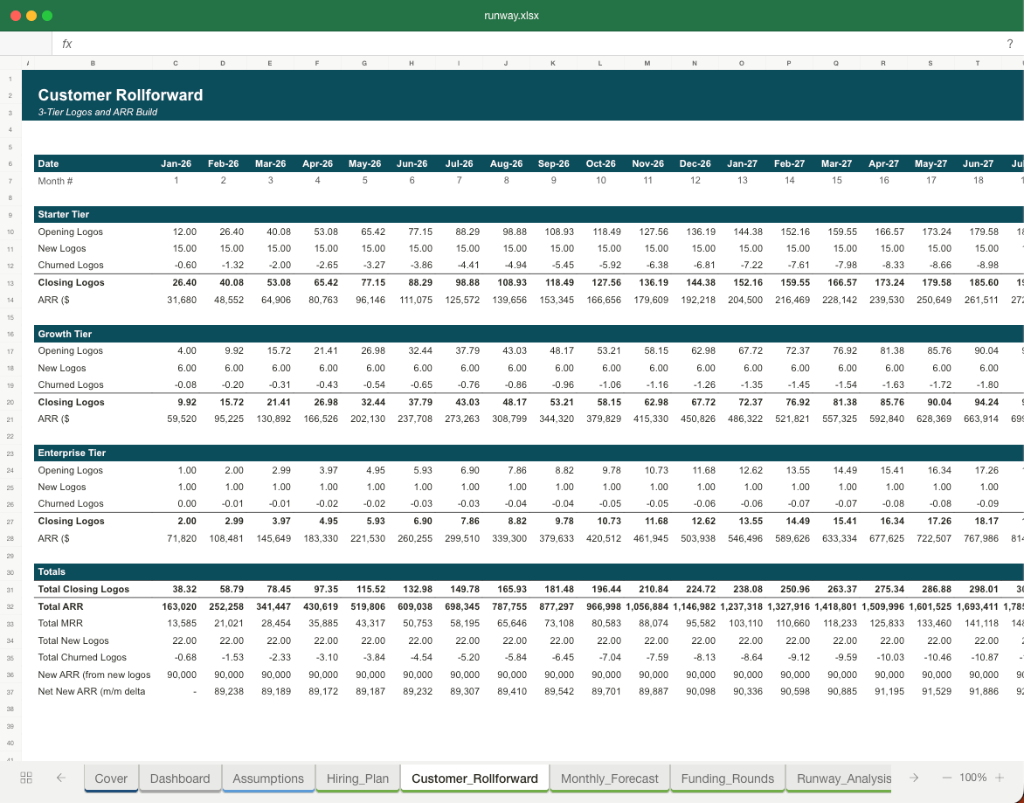
The model forecasts hospital customers, candidate supply, nurse placements, fee per placement, repeat hiring, and marketplace operations. It includes employer sales, candidate acquisition, placement support, take rate, operating headcount, gross margin, cash burn, and runway.
A turnkey financial model
Live formulas, no hardcoded values
Outputs are driven by live formulas, so the workbook updates from its assumptions instead of relying on hardcoded results.
All assumptions in one tab
Inputs are clearly marked in the Assumptions tab and separated from calculations, making it clear what to change and what to leave intact.
Statements always balancing
For integrated-statement models, the balance sheet, cash flow, and supporting schedules tie through properly.
Distinct schedules for clarity
Debt, working capital, taxes, and cash flow can get messy quickly. We group calculations in clear schedules, not across disconnected tabs.
No hidden macros or external links
There are no unexplained external workbook links or macros to undermine auditability or portability.
Changes flow through the model
Update a key driver and see the impact carry through the forecast, financing, and return outputs. We never use hardcoded numbers in formulas.
About Incredible Health
incrediblehealth.com
How to build a detailed financial model for Incredible Health
A complete walkthrough of the business, drivers, and assumptions behind the downloadable Incredible Health model - distilled from its pitch deck and publicly available information.
Product & value proposition
- Candidate-first marketplace: nurses create profiles, hospitals browse and send interview requests - inverting the traditional job-board model.
- Platform delivers hire in <30 days vs 82-day national average; claims 25× efficiency vs traditional job boards.
- Rich hospital profiles with staffing quality signals, specialty rankings, patient-experience ratings, and employer branding - designed to help nurses evaluate fit before accepting.
- NPS from both talent and employers: 86+.
- Key insight driving moat: 68% of RN candidates accept their first offer; 61% do so even when later offers carry higher pay - speed and match quality matter more than comp maximisation.
- Stanford Health Care CHRO testimonial: consistently hires in permanent roles in under three weeks.
Market
- Projected US nursing shortage: 1 million nurses short by 2024.
- Average time to hire a nurse nationally: 82 days.
- No explicit TAM/SAM/SOM dollar figures in deck.
- Implied addressable market: ~6,000+ hospitals in the US; deck focuses on IDNs, academic medical centres, community hospitals.
Revenue model
- Not explicitly stated in deck; no pricing slide.
- Business model described as "Marketplace Technology" - standard marketplace models in this category charge hospitals a placement fee (percentage of first-year salary or flat per-hire fee) and/or a subscription/seat licence for access to the candidate pool.
- Revenue model is likely per-placement fee from hospitals (common for permanent healthcare staffing marketplaces) possibly layered with a SaaS subscription for platform access. Rationale: deck emphasises "permanent nurses," speed-to-hire, and hospital-side UX - all consistent with per-hire monetisation.
Traction & metrics
- Customers: 150+ hospitals in California, including named enterprise accounts: Stanford Health Care, UCSF Medical Center, UC Davis, Cedars-Sinai, HCA, Providence, Dignity Health/CommonSpirit, Rady Children's, Cook Children's, Baylor Scott & White, and others.
- Time to hire: <30 days vs 82-day national average
- Efficiency vs job boards: 25×
- NPS (talent + employers): 86+
- Candidate acceptance rate (1st offer): 68%
- Candidate acceptance rate (1st offer even when later offers pay more): 61%
- No revenue figures, ARR, GMV, or growth rate disclosed in deck.
- Founded: 2017
Competition / moat
- Competitive framing: 25× more efficient than "traditional job boards" - implies primary displacement target is legacy boards (Indeed, LinkedIn, niche nursing boards).
- Moat sources (from deck): proprietary matching technology, candidate-centric UX (employer applies to nurse rather than reverse), rich nurse preference data, first-mover hospital relationships in California, NPS/brand reputation among RN community.
- No direct competitor named; no comp grid shown.
Team & funding ask / use of funds
- Team described as MDs, RNs, software engineers, marketers, designers; healthcare and matching-technology experts.
- Backed by "top tier Silicon Valley investors" - marketplace and matching technology experts.
- No named investors, no funding history, no ask amount, no use-of-funds breakdown in deck.
Recommended financial model
Archetype + why: Marketplace per-placement revenue model with optional SaaS subscription layer. This is closest to a "staffing marketplace" archetype - revenue driven by volume of nurse placements × average fee per placement, plus potentially a recurring platform access fee per hospital. The candidate-side is free. Model should capture both placement GMV and net revenue (take rate).
Forecast horizon & granularity:
- 3–5 year annual model (suitable for Series A/B fundraise context).
- Year 1–2 quarterly, Years 3–5 annual.
- Monthly granularity not warranted without unit-level pipeline data.
Key drivers & assumptions:
| Driver | Value |
|---|---|
| Active hospital customers (start) | 150 |
| Avg nurses hired per hospital per year | 20–40 hires/year |
| Avg placement fee per hire | $5,000–$8,000 |
| Platform/SaaS fee per hospital per month | $0–$2,000 |
| Candidate take rate | 0% |
| Time to hire | <30 days |
| NPS (demand-side proxy for churn) | 86+ |
| Hospital customer growth rate (CA) | 20–40% YoY |
| National expansion ramp | Year 2 |
| Gross margin | 60–75% |
| S&M spend as % of revenue | 25–35% |
| R&D spend as % of revenue | 15–20% |
| G&A spend as % of revenue | 8–12% |
Scenarios (Base / Bull / Bear - which variables flex):
- Base: 150 hospital clients growing 30% YoY; 25 hires/hospital/year; $6,500 placement fee; national expansion begins Y2.
- Bull: Hospital growth 50% YoY; 35 hires/hospital; layered SaaS fee of $1,000/month; faster national ramp.
- Bear: Growth slows to 15% YoY; hires/hospital drops to 15 (hospitals cautious, budget cuts); placement fee compresses to $4,500 under competition.
- Key flex variables: hires-per-hospital, placement fee, and hospital customer count are the three levers with the most P&L sensitivity.
Required sheets / outputs:
- Assumptions dashboard (all inputs in one place; colour-coded)
- Hospital customer build (cohort by entry year, churn rate, active count)
- Revenue build (placements × fee + optional SaaS)
- P&L (gross profit, EBITDA)
- Headcount model (sales, engineering, ops)
- Cash flow / runway (given no funding ask disclosed, model to show breakeven path)
- Scenario toggle (Base / Bull / Bear)
- KPI summary: hospitals, nurses placed, GMV, revenue, take rate, NPS proxy
Frequently asked
Is the Incredible Health financial model free?+
Yes. The Incredible Health model is a free Excel (.xlsx) download with live formulas. Sign up with your email and the workbook is yours to keep, review, and edit.
What's included in the model?+
A 5-year monthly forecast with P&L, cash flow and runway, valuation (exit multiple plus a DCF cross-check), MOIC/IRR returns, and unit economics, with live formulas throughout.
How was this model built?+
It was built from Incredible Health's pitch deck and publicly available information, then structured to investment-banking standards as a fully editable Excel model.
Can I change the assumptions?+
Yes. You can change assumptions and the live formulas will recalculate in the downloadable Excel model.
Have more financial modelling questions? Contact us

Created by ex-finance professionals
Hey, I’m Alex and I created Finamodel.
Over my years in the finance industry I kept building the same models over and over again. Same structure, same assumptions, different logo. So I started building frameworks to turn them into clean, reusable templates.
Every model here is one I’d actually use for a client, and I personally vet each one before it goes up.
I’m not an expert in every industry, but I’ve built enough models to know what belongs in one. And when something is completely foreign to me, I reach out to my network for experts to work on our models with us.
Having a template library on hand cuts a first build from hours to minutes.
Need help finding your model? You’ll find me in the Finamodel app!
Other Health-tech Startup Financial Models
Browse another startup in the same category.
98point6
B2B SaaS platform licensing an AI-powered virtual care technology stack to health systems, pivoted from running a direct-to-employer virtual clinic.
A-Champs
IoT-powered gamified training device (ROXs PRO) for sports/health professionals, evolving into a B2C smart coach app for families.

AccuRx
Patient-centred communication platform connecting everyone involved in a patient's care, starting with near-universal penetration in UK GP practices.

Aeris
Swiss-made premium air purifiers sold through DTC, retail, and dealer channels, with a recurring filter consumable attached to a connected mobile app.

Akido Labs
Akido Labs is a data-driven prevention platform that integrates siloed healthcare, municipal, and non-profit data to enable proactive outreach and case management for vulnerable populations (homeless, chronically ill, etc.).

Alloy
Telehealth + DTC subscription platform delivering menopause hormonal treatment (MHT) and holistic care to U.S. women 40+.

Astek Diagnostics
Point-of-care diagnostic device (Jiddu system) that confirms bacterial infections and antibiotic sensitivity in ~1 hour across four body fluid types (urine, CSF, effluent, blood).

Atom Limbs
Atom Limbs is building the first AI-powered, neural-controlled prosthetic arm sold direct-to-consumer on a subscription model.