 MedCrypt Financial Model
Health-tech Startup Financials (Free Excel Download)
SaaS platform selling cybersecurity tools to medical device manufacturers (MDMs) to achieve FDA compliance and build secure-by-design products.


professionals from Deloitte
Used by professionals from






About this model
MedCrypt sells cybersecurity tools to medical-device manufacturers building FDA-compliant secure products. Its platform helps manufacturers address security requirements across connected medical devices, where software vulnerabilities can create regulatory, clinical, and commercial risk.
The three-product SaaS suite is sold through direct enterprise relationships and can add implementation services. Accounts can expand through product modules, device programmes, regulatory milestones, and broader deployment across a manufacturer's portfolio of connected products.
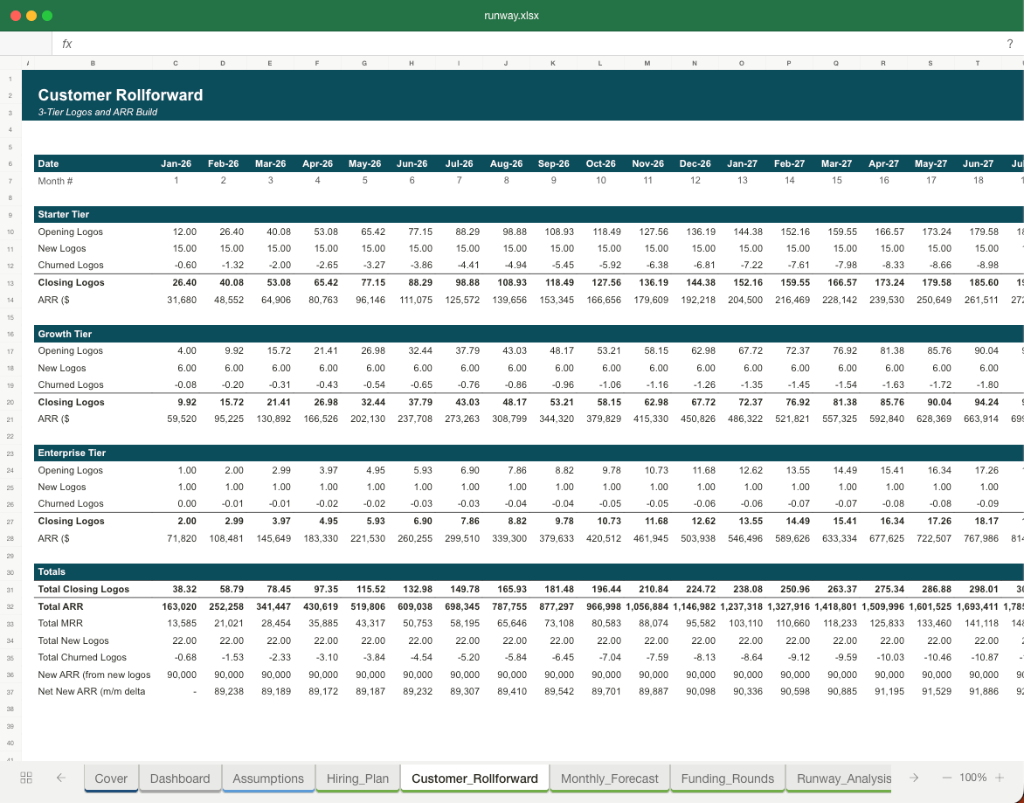
The model forecasts manufacturer logos, product-module ACV, implementation, expansion, churn, and compliance-support costs. It includes enterprise sales cycles, security and product engineering, customer success, services delivery, gross margin, cash burn, and long-term runway.
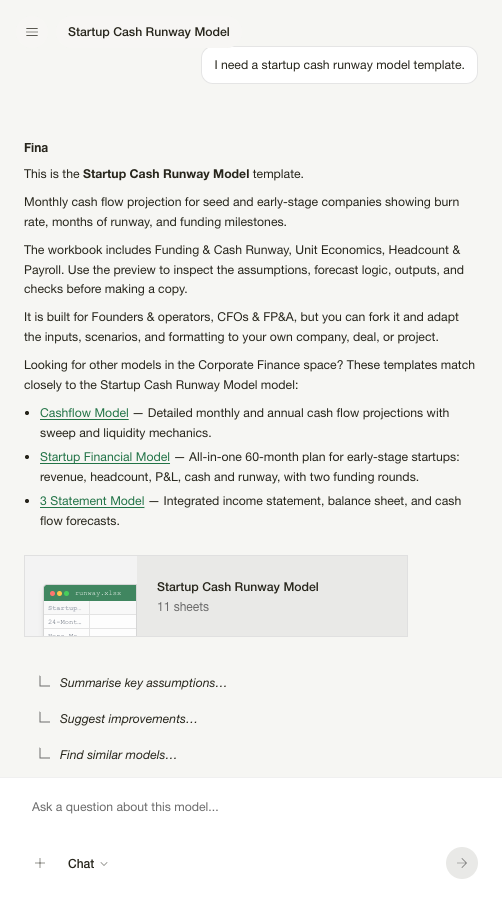
A turnkey financial model
Live formulas, no hardcoded values
Outputs are driven by live formulas, so the workbook updates from its assumptions instead of relying on hardcoded results.
All assumptions in one tab
Inputs are clearly marked in the Assumptions tab and separated from calculations, making it clear what to change and what to leave intact.
Statements always balancing
For integrated-statement models, the balance sheet, cash flow, and supporting schedules tie through properly.
Distinct schedules for clarity
Debt, working capital, taxes, and cash flow can get messy quickly. We group calculations in clear schedules, not across disconnected tabs.
No hidden macros or external links
There are no unexplained external workbook links or macros to undermine auditability or portability.
Changes flow through the model
Update a key driver and see the impact carry through the forecast, financing, and return outputs. We never use hardcoded numbers in formulas.
About MedCrypt
medcrypt.com
How to build a detailed financial model for MedCrypt
A complete walkthrough of the business, drivers, and assumptions behind the downloadable MedCrypt model - distilled from its pitch deck and publicly available information.
Product & value proposition
Three products:
- Heimdall - SBOM generation and vulnerability tracking. Generates and monitors software bills of materials across device platforms. Identifies vulnerabilities per SBOM version, tracks dependencies, forensically links vulnerabilities to device events. Works on new, existing, and embedded devices.
- Canary - Behavior monitoring for postmarket surveillance. Captures security event data and device metadata, analyzes and alerts, supports intermittent connectivity, determines if a vulnerability is being actively exploited.
- Guardian - Cryptography API. Easy-to-use API providing proven crypto primitives, unique device key pairs, customizable certificate management, wide platform support.
Value prop: helps MDMs avoid FDA rejection, hospital rejection, and recalls - all of which are increasing due to new FDA cybersecurity mandates (April 2022 draft guidance with "teeth"). Also operates MedISAO (Medical Device Information Sharing Organization), an FDA-recognized ISAO that provides sales pipeline.
Market
- Total MDM Market: $521B
- Segment breakdown:
- Diagnostic Imaging: $94B
- Patient Monitoring: $37B
- Anesthesia / Respiratory: $34B
- Diabetes: $19B
- Radiation Oncology: $6.8B
- Drug Infusion: $5B
- Neurostimulation: $4.5B
- CRM: $4.4B
- Surgical Robotics: $3.6B
- The deck frames cybersecurity as relevant across all these modalities (cybersecurity-driven recalls as common denominator).
- $1T of new and legacy devices need to be secured in the next 3 years.
- No explicit SAM, SOM, or cybersecurity-spend-as-%-of-MDM-revenue figures given.
- The framing is regulatory necessity ("MUST-HAVE FEATURES" per FDA draft guidance, April 2022), making the addressable market more defensible - it's not discretionary spend.
Revenue model
- Software subscription / SaaS licensing across three products (Heimdall, Canary, Guardian) sold to MDMs.
- No explicit pricing tiers, per-device pricing, per-seat pricing, or ACV figures disclosed in deck.
- Channel: direct sales to MDMs; MedISAO membership provides inbound pipeline.
- Customers are enterprise MDMs (including 3 of the top 5 MDMs), implying high-ACV, long-cycle enterprise sales.
- Services / professional services component implied (compliance support, integration) but not itemized.
Traction & metrics
- 55 customers
- Including 3 of the top 5 MDMs
- $14M raised to date
- Investors: Section 32, Johnson & Johnson, Y Combinator, ENIAC, and others
- No ARR, MRR, revenue growth rate, NRR, churn, or logo retention figures disclosed.
- Slide numbering visible in images goes to at least slide 22, but financial chart slides are not in the 12-slide classified set provided - possible additional financial slides not included in this deck export.
Competition / moat
- Moat sources mentioned:
- MedISAO affiliation - only MDM-focused ISAO with FDA MOU; provides pipeline and credentialing advantage.
- Regulatory expertise embedded in product (FDA cybersecurity mandates as tailwind and barrier to entry for generalist cyber vendors).
- Team pedigree: former FDA cybersecurity lead (Seth Carmody), Becton Dickinson cybersecurity (Vidya Murthy), Symantec Healthcare (Axel Wirth).
- Founders previously built and sold Gamma Basics to Varian (Mike Kijewski, Eric Pancoast).
- No named competitors mentioned in the deck.
Team & funding ask / use of funds
- Team:
- Mike Kijewski - Founder, Gamma Basics (sold to Varian)
- Eric Pancoast - Founder, Gamma Basics (sold to Varian)
- Vidya Murthy - Former Becton Dickinson cybersecurity
- Seth Carmody - Former FDA Cybersecurity Lead
- Axel Wirth - Former Symantec Healthcare Lead
- Shannon Lantzy - Former Booz Allen Hamilton
- Total raised to date: $14M
- Investors: Section 32, Johnson & Johnson, Y Combinator, ENIAC, and others
Recommended financial model
- Archetype + why: B2B SaaS ARR model - revenue is recurring subscription licensing to enterprise MDMs, with potential services attach. Classic enterprise SaaS mechanics: logo count × ACV, with net revenue retention and expansion as key drivers. Three-product suite lends itself to land-and-expand modeling (customers start with one module, expand to all three).
- Forecast horizon & granularity: 5-year annual model (Years 1–5), with Year 1 quarterly detail. Annual is appropriate for enterprise sales cycles; quarterly detail on Year 1 given deal timing uncertainty.
- Key drivers & assumptions:
- Starting customer count: 55; logo growth rate - 30–50% YoY net new logos given early growth trajectory and regulatory tailwind.
- Average ACV per customer - $80K–$150K based on enterprise MDM software pricing norms; deck does not disclose.
- Products per customer (attach rate) - 1.2x blended at start, expanding to 2.0x at year 3 as land-and-expand takes hold.
- Net Revenue Retention - 110–120% given FDA mandatory compliance creates high switching cost and expansion opportunity.
- Gross margin - 70–80% (SaaS software with some services drag); no COGS disclosed.
- Sales cycle - 6–12 months for net-new enterprise MDM; shorter for MedISAO-sourced pipeline.
- Headcount-driven OpEx: S&M, R&D, G&A built as % of revenue or as team-size model - benchmarks for Series B enterprise SaaS.
- MedISAO pipeline contribution - 20–30% of new logos sourced from ISAO channel; lower CAC than outbound.
- FDA mandate enforcement timeline - 2023–2024 acceleration in demand as premarket submission deadlines tighten.
- Scenarios (Base / Bull / Bear - which variables flex):
- Base: 30% logo growth, $100K ACV, 115% NRR, 75% gross margin.
- Bull: 50% logo growth (faster FDA enforcement), $120K ACV (multi-product bundling), 120% NRR.
- Bear: 20% logo growth (FDA enforcement delayed/softened), $80K ACV (pricing pressure from generalist entrants), 105% NRR.
- Primary scenario toggle: FDA enforcement speed and pace of regulatory conversion.
- Required sheets / outputs:
- Assumptions - all drivers consolidated with vs tags.
- Revenue build - cohort-based logo × ACV × NRR; broken out by product (Heimdall / Canary / Guardian).
- Income Statement - Revenue → Gross Profit → EBITDA → Net Loss.
- Headcount & OpEx schedule.
- Cash / Runway - given $14M raised and unknown burn, runway sensitivity is important.
- KPI dashboard - ARR, logo count, ACV, NRR, gross margin, CAC payback (once CAC disclosed/assumed).
- Scenario toggle - Base / Bull / Bear switcher on assumptions sheet.
Frequently asked
Is the MedCrypt financial model free?+
Yes. The MedCrypt model is a free Excel (.xlsx) download with live formulas. Sign up with your email and the workbook is yours to keep, review, and edit.
What's included in the model?+
A 5-year monthly forecast with P&L, cash flow and runway, valuation (exit multiple plus a DCF cross-check), MOIC/IRR returns, and unit economics, with live formulas throughout.
How was this model built?+
It was built from MedCrypt's pitch deck and publicly available information, then structured to investment-banking standards as a fully editable Excel model.
Can I change the assumptions?+
Yes. You can change assumptions and the live formulas will recalculate in the downloadable Excel model.
Have more financial modelling questions? Contact us

Created by ex-finance professionals
Hey, I’m Alex and I created Finamodel.
Over my years in the finance industry I kept building the same models over and over again. Same structure, same assumptions, different logo. So I started building frameworks to turn them into clean, reusable templates.
Every model here is one I’d actually use for a client, and I personally vet each one before it goes up.
I’m not an expert in every industry, but I’ve built enough models to know what belongs in one. And when something is completely foreign to me, I reach out to my network for experts to work on our models with us.
Having a template library on hand cuts a first build from hours to minutes.
Need help finding your model? You’ll find me in the Finamodel app!
Other Health-tech Startup Financial Models
Browse another startup in the same category.
98point6
B2B SaaS platform licensing an AI-powered virtual care technology stack to health systems, pivoted from running a direct-to-employer virtual clinic.
A-Champs
IoT-powered gamified training device (ROXs PRO) for sports/health professionals, evolving into a B2C smart coach app for families.

AccuRx
Patient-centred communication platform connecting everyone involved in a patient's care, starting with near-universal penetration in UK GP practices.

Aeris
Swiss-made premium air purifiers sold through DTC, retail, and dealer channels, with a recurring filter consumable attached to a connected mobile app.

Akido Labs
Akido Labs is a data-driven prevention platform that integrates siloed healthcare, municipal, and non-profit data to enable proactive outreach and case management for vulnerable populations (homeless, chronically ill, etc.).

Alloy
Telehealth + DTC subscription platform delivering menopause hormonal treatment (MHT) and holistic care to U.S. women 40+.

Astek Diagnostics
Point-of-care diagnostic device (Jiddu system) that confirms bacterial infections and antibiotic sensitivity in ~1 hour across four body fluid types (urine, CSF, effluent, blood).

Atom Limbs
Atom Limbs is building the first AI-powered, neural-controlled prosthetic arm sold direct-to-consumer on a subscription model.