 Oliva Financial Model
Health-tech Startup Financials (Free Excel Download)
B2B workplace mental health platform providing personalised therapy, care navigation, and manager training, sold to employers via SaaS subscription.



professionals from Deloitte
Used by professionals from






About this model
Oliva provides personalised therapy, care navigation, and manager training as a workplace mental-health benefit. It helps employers offer employees access to clinical support and guidance, while giving managers tools intended to improve the wider work environment.
It sells recurring employer contracts, likely priced per covered employee per month. Growth depends on employer wins, covered employees, engagement, therapy utilisation, clinical capacity, expansion into additional populations, and renewal through annual benefits and procurement cycles.
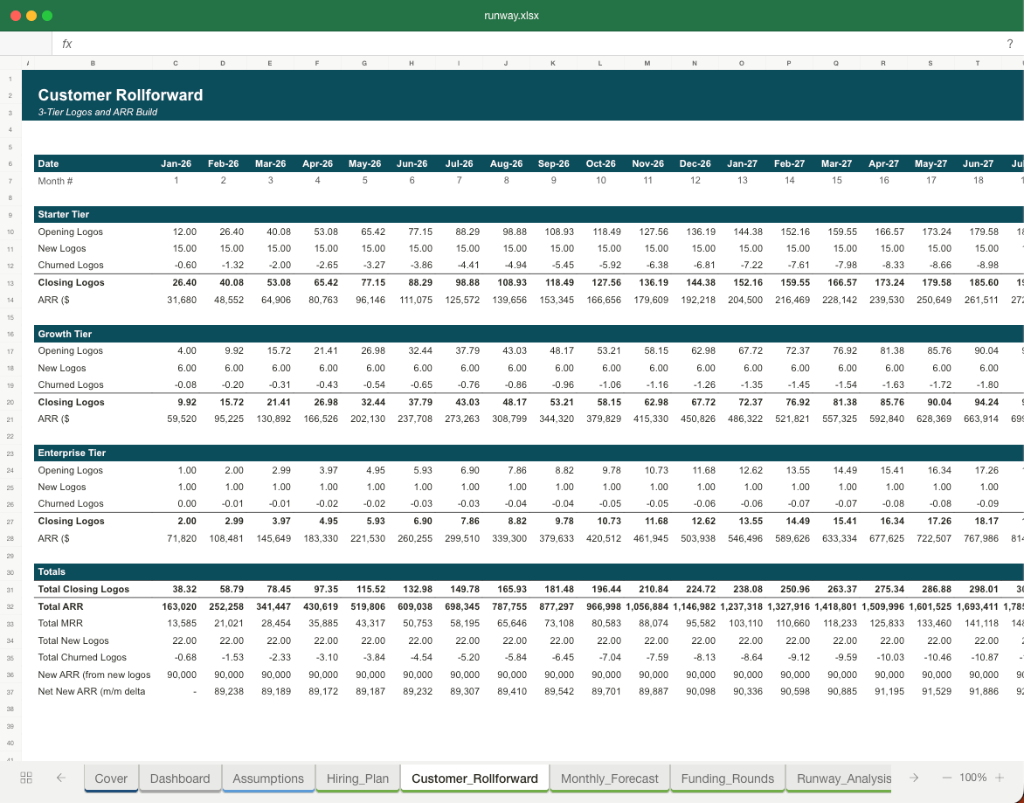
The model forecasts employers, covered employees, PEPM revenue, therapy utilisation, clinician cost, expansion, and renewal. It includes provider-network capacity, care-navigation operations, enterprise sales, customer success, gross margin, cash burn, and runway.
A turnkey financial model
Live formulas, no hardcoded values
Outputs are driven by live formulas, so the workbook updates from its assumptions instead of relying on hardcoded results.
All assumptions in one tab
Inputs are clearly marked in the Assumptions tab and separated from calculations, making it clear what to change and what to leave intact.
Statements always balancing
For integrated-statement models, the balance sheet, cash flow, and supporting schedules tie through properly.
Distinct schedules for clarity
Debt, working capital, taxes, and cash flow can get messy quickly. We group calculations in clear schedules, not across disconnected tabs.
No hidden macros or external links
There are no unexplained external workbook links or macros to undermine auditability or portability.
Changes flow through the model
Update a key driver and see the impact carry through the forecast, financing, and return outputs. We never use hardcoded numbers in formulas.
About Oliva
olivaclinic.com
How to build a detailed financial model for Oliva
A complete walkthrough of the business, drivers, and assumptions behind the downloadable Oliva model - distilled from its pitch deck and publicly available information.
Product & value proposition
- Stepped-care mental health platform for employers.
- Employee-facing:
- Digital drop-in session: one-hour video call with a trained psychologist.
- Care Navigator: personal, in-house trained mental health professional who guides the employee, answers questions, matches them to the right therapist, and maintains ongoing contact via secure instant messaging.
- Online therapy course: regular sessions (up to 6 / 16 / 25, depending on severity tier) with a matched therapist.
- Manager-facing: training workshops + on-demand 1-to-1 support sessions with a qualified psychologist.
- Platform: Slack integration; employees self-serve session booking, personal notes (encrypted), wellbeing tracking, and video sessions. Setup time ~10 minutes for HR/benefits manager.
- Quality mark: BACP (or equivalent) accredited therapists; Chief Clinical Officer leads in-house team; 98% therapist-matching success rate.
Revenue model
Not explicitly stated in deck. Inferred model:
- B2B SaaS subscription sold to employers (HR/benefits buyers), likely priced per employee per month (PEPM) - the standard model for employee-benefit platforms; no price point disclosed.
- Revenue is a function of: number of employer accounts × average company headcount × PEPM rate.
- Distribution channel: direct sales / inbound (Slack App Store integration is a discovery/activation layer).
- No freemium, marketplace fee, or per-session billing model mentioned.
Traction & metrics
- 98% therapist-matching success rate.
- Example patient outcome: 39% increase in wellbeing after 6 sessions completed. - shown as a product UI screenshot, not necessarily a portfolio average.
- No revenue figures, ARR, customer count, churn, NPS, or growth rates shown in deck.
Competition / moat
- Evidence-based stepped-care model (clinical rigour vs. generic EAP).
- In-house Chief Clinical Officer + curated, BACP-accredited therapist network.
- Care Navigator as a human concierge layer - differentiates from pure self-serve apps (Calm, Headspace for Work, etc.).
- Slack-native experience reduces friction to zero.
- Founder story (CEO: TravelPerk founder; CCO: scaled digital CBT to 100,000+ patients).
Team & funding ask / use of funds
- Javier Suarez - CEO & Co-founder. Previously: innovation lead at Booking.com; founded TravelPerk (300+ employees, thousands of corporate customers).
- Dr. Sarah Bateup - Chief Clinical Officer. BioBeat Top 50 female UK healthcare leaders; built one of the first UK digital CBT services (scaled to 100,000+ patients).
- Sançar Sahin - CMO & Co-founder. Previously: marketing at GetApp, Hotjar, Typeform (built Typeform's marketing team from scratch).
Recommended financial model
- Archetype + why: B2B SaaS PEPM model. Revenue is driven by employer client count × average seats (headcount covered) × monthly per-employee fee. This is the standard structure for HR-tech benefits platforms (Lyra Health, Modern Health, Koa Health comps). A 3-statement build is secondary; the core output is an ARR waterfall with cohort-level net revenue retention.
- Forecast horizon & granularity: 3 years, monthly for Year 1, quarterly for Years 2–3.
- Key drivers & assumptions:
- Number of new employer clients signed per quarter - ramp from 2–3/month in early quarters, growing with sales headcount additions.
- Average employee headcount per employer - target segment: 50–500 employees (mid-market tech/professional services); use 150 as base case.
- PEPM price - £8–£15/employee/month (consistent with UK mental-health-benefit platforms; no deck figure).
- Utilisation / seats covered vs. total headcount - employers typically cover 100% of headcount on contract.
- Gross revenue retention (logo churn) - 85–90% annual logo retention for Year 1–2, improving to 92%+ as product matures.
- Net revenue retention (expansion via headcount growth) - 105–110% NRR; employer headcount grows over time.
- Session delivery cost (therapist cost of revenue):
- Stepped-care model implies variable cost per utilising employee: Everyday tier ~1–2 sessions, Mild ~6, Moderate ~16, Severe ~25, weighted by prevalence estimates (~60%/30%/8%/2%).
- Therapist session cost: £40–£60/hour (UK market rate for accredited platform therapists).
- Care Navigator cost is a fixed salary cost per headcount band served.
- S&M expense - 40–60% of revenue in early years, declining with scale.
- R&D / platform cost - 20–25% of revenue.
- G&A - 10–15% of revenue.
- Gross margin - 55–70% at scale (typical for digitally-delivered therapy platforms); lower initially due to Navigator fixed cost and low utilisation.
- Scenarios (Base / Bull / Bear - which variables flex):
- Base: 3 new employer clients/month by Month 12, £10 PEPM, 150 avg headcount, 88% logo retention.
- Bull: Faster sales ramp (5 clients/month by Month 12), £12 PEPM, better NRR (112%), higher avg headcount (200).
- Bear: Slow sales cycle (1.5 clients/month), price compression (£8 PEPM), higher churn (80% logo retention), elevated therapist costs.
- Required sheets / outputs:
- Assumptions - all drivers in one editable block.
- Client ARR Waterfall - new, churned, expansion MRR/ARR by cohort.
- Revenue Build - employer clients × headcount × PEPM.
- Cost of Revenue - session delivery cost by care tier (utilisation × sessions × therapist cost).
- P&L - gross profit, OpEx (S&M, R&D, G&A), EBITDA, net loss.
- Headcount Plan - sales reps, care navigators, engineers, clinical staff.
- Cash / Runway - burn rate and months of runway (critical given no funding data; to be populated once raise details are known).
- Scenario toggle - Base / Bull / Bear switcher.
Frequently asked
Is the Oliva financial model free?+
Yes. The Oliva model is a free Excel (.xlsx) download with live formulas. Sign up with your email and the workbook is yours to keep, review, and edit.
What's included in the model?+
A 5-year monthly forecast with P&L, cash flow and runway, valuation (exit multiple plus a DCF cross-check), MOIC/IRR returns, and unit economics, with live formulas throughout.
How was this model built?+
It was built from Oliva's pitch deck and publicly available information, then structured to investment-banking standards as a fully editable Excel model.
Can I change the assumptions?+
Yes. You can change assumptions and the live formulas will recalculate in the downloadable Excel model.
Have more financial modelling questions? Contact us

Created by ex-finance professionals
Hey, I’m Alex and I created Finamodel.
Over my years in the finance industry I kept building the same models over and over again. Same structure, same assumptions, different logo. So I started building frameworks to turn them into clean, reusable templates.
Every model here is one I’d actually use for a client, and I personally vet each one before it goes up.
I’m not an expert in every industry, but I’ve built enough models to know what belongs in one. And when something is completely foreign to me, I reach out to my network for experts to work on our models with us.
Having a template library on hand cuts a first build from hours to minutes.
Need help finding your model? You’ll find me in the Finamodel app!
Other Health-tech Startup Financial Models
Browse another startup in the same category.
98point6
B2B SaaS platform licensing an AI-powered virtual care technology stack to health systems, pivoted from running a direct-to-employer virtual clinic.
A-Champs
IoT-powered gamified training device (ROXs PRO) for sports/health professionals, evolving into a B2C smart coach app for families.

AccuRx
Patient-centred communication platform connecting everyone involved in a patient's care, starting with near-universal penetration in UK GP practices.

Aeris
Swiss-made premium air purifiers sold through DTC, retail, and dealer channels, with a recurring filter consumable attached to a connected mobile app.

Akido Labs
Akido Labs is a data-driven prevention platform that integrates siloed healthcare, municipal, and non-profit data to enable proactive outreach and case management for vulnerable populations (homeless, chronically ill, etc.).

Alloy
Telehealth + DTC subscription platform delivering menopause hormonal treatment (MHT) and holistic care to U.S. women 40+.

Astek Diagnostics
Point-of-care diagnostic device (Jiddu system) that confirms bacterial infections and antibiotic sensitivity in ~1 hour across four body fluid types (urine, CSF, effluent, blood).

Atom Limbs
Atom Limbs is building the first AI-powered, neural-controlled prosthetic arm sold direct-to-consumer on a subscription model.