 Productsup Financial Model
Consumer/DTC Startup Financials (Free Excel Download)
Enterprise SaaS platform that manages product-to-consumer (P2C) data flows - syncing product information from brands/retailers across all digital commerce channels at scale.



professionals from Deloitte
Used by professionals from






About this model
Productsup is enterprise software for managing product-to-consumer data flows across digital-commerce channels. It helps brands and retailers synchronise product information, content, and feeds at scale, reducing the operational complexity of large catalogues and many selling destinations.
The company is a global, subscription-led platform headquartered in Berlin with seven offices worldwide. Its enterprise customers can expand across five modules, products managed, integrations, and international operations, while product exports can act as a useful leading indicator for account growth.
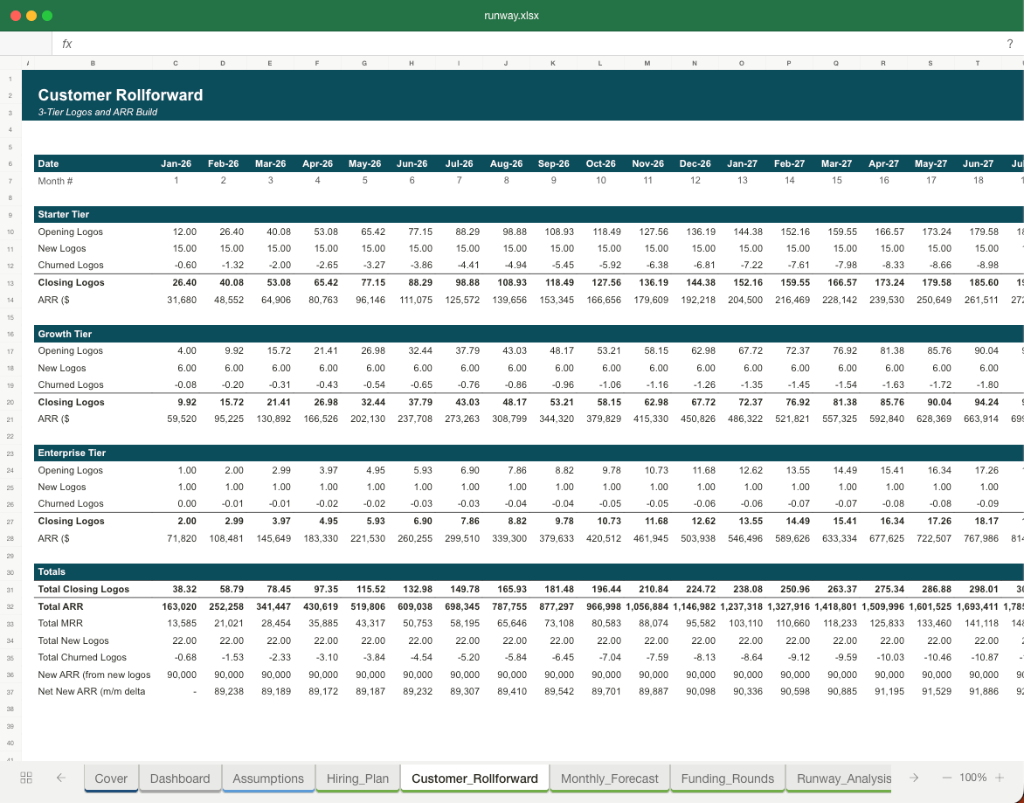
The model builds ARR from new customers, ACV, module adoption, product volumes, expansion, and churn. Implementation, data processing, sales capacity, gross margin, and net revenue retention connect the commercial plan to operating expenses and cash runway.
A turnkey financial model
Live formulas, no hardcoded values
Outputs are driven by live formulas, so the workbook updates from its assumptions instead of relying on hardcoded results.
All assumptions in one tab
Inputs are clearly marked in the Assumptions tab and separated from calculations, making it clear what to change and what to leave intact.
Statements always balancing
For integrated-statement models, the balance sheet, cash flow, and supporting schedules tie through properly.
Distinct schedules for clarity
Debt, working capital, taxes, and cash flow can get messy quickly. We group calculations in clear schedules, not across disconnected tabs.
No hidden macros or external links
There are no unexplained external workbook links or macros to undermine auditability or portability.
Changes flow through the model
Update a key driver and see the impact carry through the forecast, financing, and return outputs. We never use hardcoded numbers in formulas.
About Productsup
productsup.com
How to build a detailed financial model for Productsup
A complete walkthrough of the business, drivers, and assumptions behind the downloadable Productsup model - distilled from its pitch deck and publicly available information.
Product & value proposition
Five integrated SaaS modules on a single P2C platform:
- A. Seller/Vendor Onboarding - many-to-one; aggregate thousands of supplier catalogues
- B. Product Content Syndication - one-to-many; auto-create electronic product catalogues for retailer/distributor networks
- C. Marketplace Experience & Social Commerce - bi-directional; sell products on marketplaces and social channels, sync orders/shipments
- D. Product Feed Management - one-to-many; create high-quality feeds for search, shopping, social channels; no-code visual mapping interface (patented)
- E. Performance Insights - end-to-end product and service-level insights for performance marketing teams
Key technical differentiators:
- Proprietary processing infrastructure: ~50x more cost-effective than AWS
- Scale: 2 trillion+ monthly product exports
- 2,500+ channel integrations
- No-code UX with AI support for unstructured data
- ISO certified, GDPR/CCPA compliant
- Official partner: Facebook, Google, TikTok, Pinterest, Amazon
Market
- P2C TAM: $11.4bn (2021, global) - Constellation Research methodology; calculated by summing maturity-weighted share of adjacent categories:
- Feed Management $1.0bn (30% weighting)
- Marketing Analytics $3.5bn (20%)
- PIM $11.2bn (30%)
- DAM $3.8bn (20%)
- MDM $11.8bn (10%)
- Marketing Automation $4.6bn (40%)
- e-Commerce $7.5bn (30%)
- CDP $2.0bn (50%)
Revenue model
- SaaS subscription - ARR-based
- Pricing basis: Not explicitly stated (no per-seat, per-feed, or tiered pricing disclosed)
- Likely enterprise ACV pricing given customer profile (Walmart, HP, Sephora, Puma, Delivery Hero, Uber Eats, Beiersdorf)
- Go-to-market: Direct enterprise sales (CSO from Salesforce/Google background); 7 global offices supporting enterprise adoption
- Channel partnerships with platforms (Facebook, Google, TikTok, Pinterest, Amazon) likely drive referral/co-sell
Traction & metrics
- 300+ leading customers
- Net new ARR growing >60% in the last twelve months
- Product exports growing at 100%+ CAGR
- 2 trillion+ monthly product exports processed
- ~250 global employees (as of Dec-21; ~240 as of Oct-21)
- ~80 tech team FTEs (as of Dec-21; ~70 as of Oct-21)
- Customer logos: Uber Eats, Delivery Hero, HP, Sephora, Macy's, Puma, Beiersdorf, Walmart
Competition / moat
Positioning: Only independent P2C platform; competitors are point solutions (PIM, DAM, Feed Management tools) that address parts of the value chain, not the whole.
Moat sources claimed:
- Proprietary infrastructure with structural cost advantage (~50x vs. AWS) - hard to replicate
- Patented visual mapping / no-code UX
- First-mover in social commerce and rich media capabilities
- Scale-based data network effect (2trn+ exports, constant feedback loops build P2C intelligence)
- Deepest channel integrations (2,500+)
- Platform partner status with Facebook, Google, TikTok, Pinterest, Amazon
Team & funding ask / use of funds
Leadership:
- CEO: Vincent Peters - joined 2020; 30+ yrs at Oracle, Siebel, Qlik, TIBCO
- CIO & Co-Founder: Marcel Hollerbach - joined 2012
- COO: Stefan Sonntag - joined 2020; 27+ yrs at Qlik, Oracle
- CPO: Thomas Kasemir - joined 2021; 20+ yrs at Informatica, IBM
- CSO: Christian Reichert - joined 2019; ex-Salesforce, Google
- CMO: Lisette Huyskamp - joined 2021; ex-HP, Qlik, Optimizely
- CTO: Boris Penck - joined 2012; 15+ yrs
- Chief People & Culture: Meike Jordan - joined 2017; ex-Bosch
- CFO: Currently hiring
- Advisory Board: Johannis Hatt (Co-Founder), Kai Seefeldt (Co-Founder)
Recommended financial model
- Archetype + why: SaaS ARR model with enterprise cohort build. The business is subscription-based, ARR-driven, enterprise-focused with a long sales cycle and upsell potential across five modules. Standard SaaS ARR waterfall (new ARR + expansion - churn = net new ARR) is the natural archetype. Usage metrics (product exports) can serve as a leading indicator / expansion driver overlay.
- Forecast horizon & granularity: 5-year annual (2022–2026), with Year 1 monthly for cash burn visibility given CFO is being hired and likely fundraising. Quarterly thereafter.
- Key drivers & assumptions:
| Driver | Value / Assumption |
|---|---|
| Base ARR (start of model, FY2021) | Unknown - not disclosed |
| Net new ARR growth rate, Y1 | >60% YoY |
| Net new ARR growth rate, Y2–Y5 | Step-down: 50% / 40% / 30% / 25% |
| Gross Revenue Retention (GRR) | 85–90% |
| Net Revenue Retention (NRR) | 110–120% |
| Average ACV (new logo) | ~$80–120k |
| New logos per year (Y1) | ~50–80 |
| Gross margin | 70–75% |
| S&M as % of revenue | 35–45% |
| R&D as % of revenue | 20–25% |
| G&A as % of revenue | 10–12% |
| Headcount growth | ~30–40% YoY Y1–2, decelerating |
| Geographic mix | Global (EU-heavy given Berlin HQ + 7 offices) |
- Scenarios (Base / Bull / Bear - which variables flex):
- Base: Net new ARR growth at 55%, NRR 115%, GRR 87%, gross margin 72%
- Bull: Net new ARR growth at 75% (momentum sustains), NRR 125% (strong upsell across 5 modules), gross margin 76% (proprietary infra scales)
- Bear: Growth decelerates to 35% (macro/enterprise sales cycle slowdown), NRR 105%, GRR 82% (churn risk in smaller enterprise segment), gross margin 68%
- Required sheets / outputs:
- Assumptions - all drivers, with / tags
- ARR Waterfall - beginning ARR + new logo ARR + expansion ARR - churned ARR = ending ARR, by year/quarter
- P&L (SaaS income statement) - revenue, COGS, gross profit, S&M, R&D, G&A, EBITDA, net income
- Headcount Plan - by department (Sales, R&D, G&A, CS), tied to cost model
- Cash Flow / Runway - operating cash flow, capex (likely minimal - SaaS), ending cash; critical given CFO hiring and likely fundraise
- KPI Dashboard - ARR, NRR, GRR, LTV/CAC (modeled), Rule of 40, burn multiple
- Scenario Toggle - Base / Bull / Bear switch on key variables
Frequently asked
Is the Productsup financial model free?+
Yes. The Productsup model is a free Excel (.xlsx) download with live formulas. Sign up with your email and the workbook is yours to keep, review, and edit.
What's included in the model?+
A 5-year monthly forecast with P&L, cash flow and runway, valuation (exit multiple plus a DCF cross-check), MOIC/IRR returns, and unit economics, with live formulas throughout.
How was this model built?+
It was built from Productsup's pitch deck and publicly available information, then structured to investment-banking standards as a fully editable Excel model.
Can I change the assumptions?+
Yes. You can change assumptions and the live formulas will recalculate in the downloadable Excel model.
Have more financial modelling questions? Contact us

Created by ex-finance professionals
Hey, I’m Alex and I created Finamodel.
Over my years in the finance industry I kept building the same models over and over again. Same structure, same assumptions, different logo. So I started building frameworks to turn them into clean, reusable templates.
Every model here is one I’d actually use for a client, and I personally vet each one before it goes up.
I’m not an expert in every industry, but I’ve built enough models to know what belongs in one. And when something is completely foreign to me, I reach out to my network for experts to work on our models with us.
Having a template library on hand cuts a first build from hours to minutes.
Need help finding your model? You’ll find me in the Finamodel app!
Other Consumer/DTC Startup Financial Models
Browse another startup in the same category.
Accel Club
Accel Club acquires Amazon third-party (FBA) seller businesses at 3–4x EV/EBITDA and scales them through operational integration, then exits at higher consumer/D2C multiples.
Afrocenchix
D2C brand selling natural, vegan-certified hair-care products for afro and curly hair.

Amperity
Enterprise Customer Data Platform (CDP) that unifies first-, second-, and third-party customer data across siloed systems to power personalization, analytics, and marketing activation.

AnyRoad
Enterprise SaaS platform for managing, measuring, and optimising branded experiential marketing.
Attentive
B2B SMS / mobile marketing SaaS for e-commerce and retail brands.

Aura
All-in-one consumer "intelligent safety" subscription replacing fragmented point solutions for identity, device, WiFi, social, assets, and privacy protection.

Belgian Boys
Belgian-inspired premium specialty food brand selling cookies, refrigerated cheesecakes, frozen waffles/crepes, and snacks through US retail and DTC channels.
Bespoken Spirits
Technology company that replaces barrel aging with a proprietary ACTivation process to produce premium, customizable spirits in days rather than decades.