 Tia Financial Model
Health-tech Startup Financials (Free Excel Download)
Full-stack primary care delivery platform for women, combining virtual and in-person care under one brand.



professionals from Deloitte
Used by professionals from






About this model
Tia is a full-stack primary-care platform for women, combining virtual and in-person care under one brand. Its integrated approach requires both technology and physical care-delivery operations, with the member experience spanning routine primary care and a network of clinics.
Revenue can arise through memberships, reimbursement, or institutional contracts, but the operational model depends on clinics, visits, clinician capacity, and local density. Growth therefore requires synchronising market launch, facility investment, care-team hiring, member acquisition, and retention.
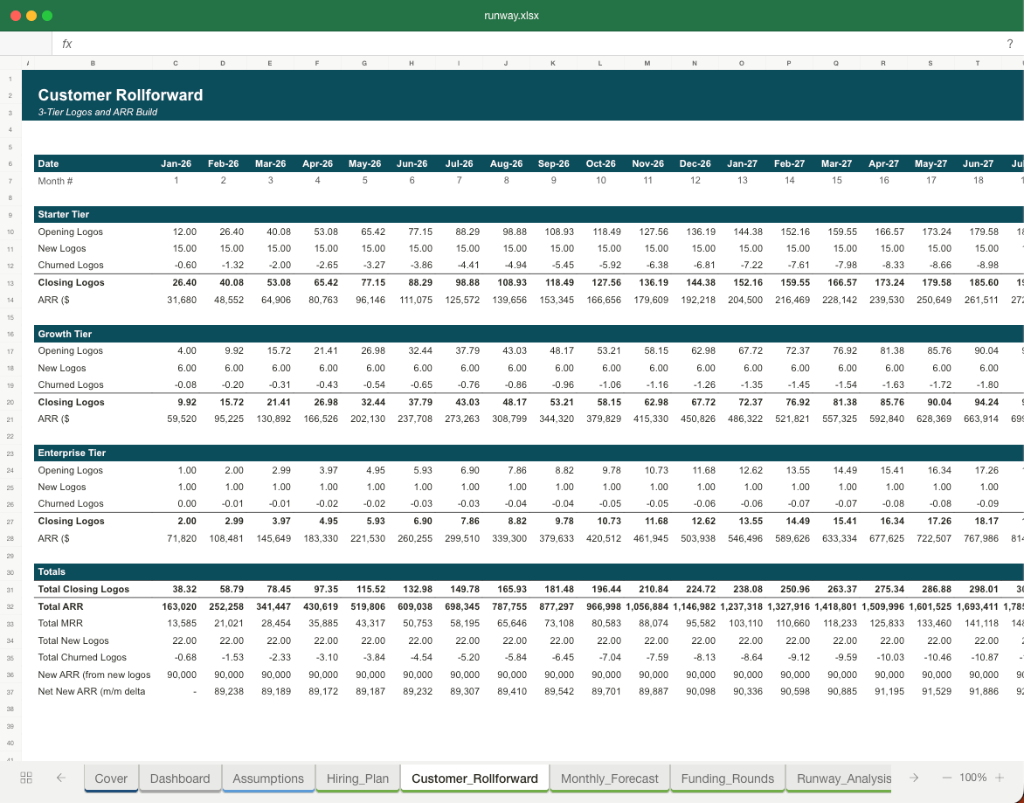
The model forecasts members, clinic locations, visits, reimbursement or membership revenue, clinician capacity, facility cost, and retention. It includes provider labour, build-out, technology, marketing, gross margin, working capital, cash burn, funding needs, and runway.
A turnkey financial model
Live formulas, no hardcoded values
Outputs are driven by live formulas, so the workbook updates from its assumptions instead of relying on hardcoded results.
All assumptions in one tab
Inputs are clearly marked in the Assumptions tab and separated from calculations, making it clear what to change and what to leave intact.
Statements always balancing
For integrated-statement models, the balance sheet, cash flow, and supporting schedules tie through properly.
Distinct schedules for clarity
Debt, working capital, taxes, and cash flow can get messy quickly. We group calculations in clear schedules, not across disconnected tabs.
No hidden macros or external links
There are no unexplained external workbook links or macros to undermine auditability or portability.
Changes flow through the model
Update a key driver and see the impact carry through the forecast, financing, and return outputs. We never use hardcoded numbers in formulas.
About Tia
asktia.com
How to build a detailed financial model for Tia
A complete walkthrough of the business, drivers, and assumptions behind the downloadable Tia model - distilled from its pitch deck and publicly available information.
Product & value proposition
- "The Modern Medical Home for Women" - a one-stop-shop delivering primary care, gynecology, therapy, acupuncture, and nutrition in one integrated platform.
- Care delivered across three modes: virtual, in-person (Tia clinics), and asynchronous (chat/messaging).
- Differentiation from femtech point-solutions: treats the whole person across all life stages (puberty to menopause), not just a single condition or reproductive window.
- Differentiates from virtual-only players: physical procedures (Pap smear, IUD, ultrasound) require in-person presence.
- Proprietary tech stack: "three screens" - patient app, provider scheduling/EMR, and care team collaboration tool ("Tia for doctors," described as "Asana for Care Teams").
- Care team model: each patient assigned to a collaborative team (MD, NP, therapist, acupuncturist, care coordinator, etc.) rather than a single PCP.
Market
- U.S. total healthcare system spend: $3.5 trillion (~$700B men-controlled + $2.8T women-controlled).
- Women control >80% of total U.S. healthcare dollars = $2.8 trillion in annual spend.
- No formal TAM/SAM/SOM breakdown or funnel presented.
- Market framing: healthcare shifting from hospital to outpatient; virtual care now a commodity; women identified as "most powerful and underserved customer in healthcare."
Revenue model
- Primary revenue: fee-for-service billed through insurance (in-network contracts with health systems improve contracted rates and per-patient revenue).
- Secondary revenue (scaling): PMPM (per-member-per-month) management fees paid by health system partners - described as "annual subscription revenue" for delivering women's healthcare.
- Health systems also provide financial support to offset clinic stand-up costs, making new "boxes" cash-flow positive on day one.
- Access to specialist referral infrastructure (OB, L&D, NICU, GYN surgery) provided via health system partnerships, enabling higher-acuity integrated care.
- No membership fee, subscription tier, or direct-to-consumer pricing explicitly stated in deck.
Traction & metrics
- >60% of care is delivered virtually.
- 40% lower cost per service compared to a typical PCP.
- Women control >80% of $3.5T U.S. healthcare spend, framed as addressable market.
- Testimonials dated as early as May 2021; Silver Lake clinic referenced as open.
- No patient count, revenue figure, growth rate, appointment volume, or ARR disclosed in deck.
Unit economics
- 40% lower cost per service vs. typical PCP.
- Brand flywheel described as driving acquisition "faster and cheaper than anyone else in the industry" via organic content + paid ads + viral UGC - implying low CAC, but no dollar figure given.
- Health system partnerships described as making new clinic locations cash-flow positive on day one.
- No explicit CAC, LTV, gross margin, contribution margin, or payback period stated.
Competition / moat
- Competitive positioning: against (a) femtech point-solutions (single-condition), (b) virtual-only telehealth players (limited scope), (c) traditional fragmented healthcare system.
- Moat described as three-part: Brand (trusted, viral UGC, fangirl flywheel) + Care model (whole-person, care team) + Tech (proprietary EMR/care coordination platform).
- No named competitors cited in deck.
Team & funding ask / use of funds
- Co-founder & CEO: Carolyn Witte - ex-Google Creative Lab; brand, marketing, partnerships.
- Co-founder & CPOO: Felicity Yost - former PM at Owler & Bridgewater; technology, data, operations.
Recommended financial model
- Archetype + why: Hybrid care delivery P&L with dual revenue streams - (1) fee-for-service / insurance reimbursement per clinical visit (clinic-based revenue), and (2) PMPM subscription fees from health system partners (B2B recurring revenue). The model sits at the intersection of a multi-site clinic roll-out model and a SaaS-style B2B recurring revenue layer. A 3-statement integrated model is appropriate given capex for clinic build-outs, working capital from insurance billing cycles, and the need to track path to profitability by clinic cohort.
- Forecast horizon & granularity: 5 years (Year 1–5), monthly for Years 1–2 (clinic ramp and cash burn visibility), annual for Years 3–5 (scale). Clinic-level P&L + consolidated roll-up.
- Key drivers & assumptions:
*Clinic roll-out:*
- Number of clinics open (existing + new openings per year): Silver Lake open as of 2021; total count not stated. 3–5 clinics at time of deck, 2–4 new openings/year; rationale: early-stage multi-city roll-out typical for this stage.
- Patients per clinic capacity: 800–1,200 active members per clinic; rationale: primary care panel norms, scaled down for hybrid model.
- Ramp period per new clinic to full capacity: 6–12 months; rationale: pre-opening waitlist noted in deck (marketing flywheel builds waitlist before doors open), so ramp faster than greenfield.
*Clinical revenue (fee-for-service):*
- Visits per patient per year: 4–6; rationale: primary care + GYN average annual touchpoints.
- Revenue per visit (insurance reimbursement): $150–$250 blended; rationale: primary care + GYN mix, discounted for in-network rates.
- Virtual visit % of total: >60%; lower cost to deliver.
- Cost per service vs. PCP benchmark: 40% lower, used to model provider labor cost.
*B2B PMPM revenue:*
- Number of health system partners: 1–3 at time of deck, scaling with clinic openings.
- Covered lives per partner (attributed to Tia): 5,000–20,000; rationale: health system pilots typically start with employee populations or attributed panels.
- PMPM fee: $15–$40/member/month; rationale: primary care PMPM benchmarks for value-based/capitated arrangements.
*Cost structure:*
- Provider labor (largest cost; NPs cheaper than MDs - model mix): 50–60% of clinical revenue.
- Clinic occupancy / build-out (capex offset by health system support per deck): health systems provide financial support for stand-up; net capex per box $500K–$1.5M after partner contribution.
- Tech/ops overhead (homegrown platform): flat fixed cost scaling slowly; rationale: already built, incremental hosting + engineering.
- G&A and marketing: 20–30% of revenue at current scale, declining as flywheel matures.
*Path to profitability:*
- Clinic-level EBITDA breakeven: Month 12–18 post-opening; rationale: day-one cash-flow-positive framing in deck implies fast ramp.
- Scenarios (Base / Bull / Bear - which variables flex):
- Bull: 4+ clinic openings/year, PMPM deals close faster, virtual visit % rises to 70%+, CAC stays near zero via UGC flywheel.
- Base: 2–3 openings/year, 1 new health system partner/year, mix of B2C and B2B at equal weight.
- Bear: Clinic ramp delayed, insurance reimbursement rates under pressure, health system partnerships slow to close, higher provider labor cost if NP-to-MD ratio shifts.
- Required sheets / outputs:
- Assumptions - all drivers above, toggle Base/Bull/Bear.
- Clinic Roll-Out Schedule - opening dates, ramp curves, capacity by clinic.
- Clinical Revenue Model - visits × reimbursement rate × virtual/in-person mix.
- B2B PMPM Revenue Model - partners × covered lives × PMPM × months.
- Clinic P&L (unit economics per box) - revenue, provider labor, occupancy, contribution margin.
- Consolidated P&L - blended across all clinics + B2B layer.
- Balance Sheet - capex (clinic build-outs), AR from insurance billing (60–90 day collection lag), deferred revenue (PMPM prepayments).
- Cash Flow Statement - operating cash, capex, health system partner contributions.
- Headcount Plan - clinical staff (by clinic) + central G&A.
- KPI Dashboard - active patients, visits/month, virtual %, PMPM contracts, revenue per patient, clinic-level EBITDA margin.
Frequently asked
Is the Tia financial model free?+
Yes. The Tia model is a free Excel (.xlsx) download with live formulas. Sign up with your email and the workbook is yours to keep, review, and edit.
What's included in the model?+
A 5-year monthly forecast with P&L, cash flow and runway, valuation (exit multiple plus a DCF cross-check), MOIC/IRR returns, and unit economics, with live formulas throughout.
How was this model built?+
It was built from Tia's pitch deck and publicly available information, then structured to investment-banking standards as a fully editable Excel model.
Can I change the assumptions?+
Yes. You can change assumptions and the live formulas will recalculate in the downloadable Excel model.
Have more financial modelling questions? Contact us

Created by ex-finance professionals
Hey, I’m Alex and I created Finamodel.
Over my years in the finance industry I kept building the same models over and over again. Same structure, same assumptions, different logo. So I started building frameworks to turn them into clean, reusable templates.
Every model here is one I’d actually use for a client, and I personally vet each one before it goes up.
I’m not an expert in every industry, but I’ve built enough models to know what belongs in one. And when something is completely foreign to me, I reach out to my network for experts to work on our models with us.
Having a template library on hand cuts a first build from hours to minutes.
Need help finding your model? You’ll find me in the Finamodel app!
Other Health-tech Startup Financial Models
Browse another startup in the same category.
98point6
B2B SaaS platform licensing an AI-powered virtual care technology stack to health systems, pivoted from running a direct-to-employer virtual clinic.
A-Champs
IoT-powered gamified training device (ROXs PRO) for sports/health professionals, evolving into a B2C smart coach app for families.

AccuRx
Patient-centred communication platform connecting everyone involved in a patient's care, starting with near-universal penetration in UK GP practices.

Aeris
Swiss-made premium air purifiers sold through DTC, retail, and dealer channels, with a recurring filter consumable attached to a connected mobile app.

Akido Labs
Akido Labs is a data-driven prevention platform that integrates siloed healthcare, municipal, and non-profit data to enable proactive outreach and case management for vulnerable populations (homeless, chronically ill, etc.).

Alloy
Telehealth + DTC subscription platform delivering menopause hormonal treatment (MHT) and holistic care to U.S. women 40+.

Astek Diagnostics
Point-of-care diagnostic device (Jiddu system) that confirms bacterial infections and antibiotic sensitivity in ~1 hour across four body fluid types (urine, CSF, effluent, blood).

Atom Limbs
Atom Limbs is building the first AI-powered, neural-controlled prosthetic arm sold direct-to-consumer on a subscription model.