VIVital Financial Model
Health-tech Startup Financials (Free Excel Download)
AI + UI platform for hospital emergency departments - patient engagement, follow-up automation, and clinical decision support sold as SaaS to health systems.



professionals from Deloitte
Used by professionals from






About this model
Vital sells AI and user-interface software for hospital emergency departments, covering patient engagement, follow-up automation, and clinical decision support. It helps health systems improve the emergency-department experience and operational follow-through across a high-volume, time-sensitive care setting.
The platform can be sold as a subscription or usage-linked enterprise product, with expansion through ED volume, sites, workflow modules, and clinician adoption. Customer value depends on successful implementation, integration into clinical operations, patient engagement, and retention within hospital systems.
The model forecasts hospital logos, ED volume, subscription or usage fees, implementation, clinician adoption, expansion, and churn. It includes AI and cloud costs, clinical integration, sales cycles, customer success, product investment, gross margin, cash burn, and runway.
A turnkey financial model
Live formulas, no hardcoded values
Outputs are driven by live formulas, so the workbook updates from its assumptions instead of relying on hardcoded results.
All assumptions in one tab
Inputs are clearly marked in the Assumptions tab and separated from calculations, making it clear what to change and what to leave intact.
Statements always balancing
For integrated-statement models, the balance sheet, cash flow, and supporting schedules tie through properly.
Distinct schedules for clarity
Debt, working capital, taxes, and cash flow can get messy quickly. We group calculations in clear schedules, not across disconnected tabs.
No hidden macros or external links
There are no unexplained external workbook links or macros to undermine auditability or portability.
Changes flow through the model
Update a key driver and see the impact carry through the forecast, financing, and return outputs. We never use hardcoded numbers in formulas.
About Vital
vital.co
How to build a detailed financial model for Vital
A complete walkthrough of the business, drivers, and assumptions behind the downloadable Vital model - distilled from its pitch deck and publicly available information.
Product & value proposition
Three modules, each sold as an add-on tier:
- ERAdvisor (Patient) - no-download web app delivered via SMS at registration; AI-powered wait times, multi-lingual, labs/imaging education, family sharing, follow-up scheduling. Deployed at 60+ hospitals.
- ED Follow-Up AI - post-discharge AI that stratifies patients by value (high → human call, medium → automated, low → SMS) to capture new patient revenue. Deployed at 10 hospitals.
- Clinical - lite mobile EHR, AI alerts (admission likelihood, readmission risk, missed billing). Trial at 2 hospitals.
Core pitch: ED is treated as a cost center; Vital turns it into a retention and revenue engine for the health system.
Market
- 5,250 EDs in the US.
- 140M ED visits/yr in the US, increasing.
- ~$2,000 avg visit cost → $300B total ED spend = 25% of all US hospital spend.
- 40% of ED patients are new to the health system; 70% of all hospital admits and 70% of new diagnoses originate in the ED.
- ~60% of US market can be reached without hospital IT involvement (via existing EHR/ADT connectivity partners: Redox, CollectiveMedical, PatientPing, Audacious Inquiry).
- SAM (no-IT-required): ~3,150 EDs.
- SOM stated: 480+ hospitals (9% of US market) via expansion of existing health system relationships.
- No explicit TAM/SAM dollar figures in deck beyond ED spend context.
Revenue model
- Pricing tiers (per facility per month):
- Tier 0 - Free (3-month trial): $0/facility/mo
- Tier 1 - ERAdvisor: $5k/facility/mo ($60k/yr)
- Tier 2 - ERAdvisor + ED Follow-Up AI: $10k/facility/mo ($120k/yr)
- Tier 3 - Full suite (eventual): ~$500k/yr/facility
- Average ACV today: ~$100k/hospital.
- Billing: monthly per facility.
- Sales motion: pilot (free, 3 months) → paid contract → upsell additional modules.
- Sales cycle compressed to 2–4 months (from industry standard 12–18 months) via no-IT-required deployment.
- Channel: direct enterprise sales to health systems; leverages existing EHR integrations.
Traction & metrics
- Hospitals: 67 hospitals, 13 health systems.
- Hospital count by month (Nov–Mar): ~5 → ~11 → ~12 → ~38 → ~60.
- Of ~60 in Mar: ~19 contracted (green), ~41 pilots started (blue).
- Expansion pipeline: 480+ hospitals across existing health system relationships (UPMC 40 total, Ascension 150, Tenet 65, AdventHealth 50, Emory 6, etc.).
- Patient volume: 250k patients + family/yr now; ~400k/yr end Q2 '21; ~1M+/yr end Q4 '21.
- Adoption rate: 50–60% of patients with mobile numbers use the product (64%, 57%, 58%, 51% across four Emory EDs).
- Revenue at Emory (4 EDs): $7M+ in new revenue attributed to Vital; $5M+ immediate new revenue from Follow-Up AI alone.
- Clinical AI trial: identified $3M/yr/ED in missed supply billing and $1M+/yr/ED in missed critical care billing.
- Visit length: 13-minute decrease in visit length.
- Staff burden: 1,500 fewer questions/month.
- Patient satisfaction: 97% satisfaction rating on ERAdvisor.
- HCAHPS (Dignity Health SJHMC): +38% on "information about delays"; +226% likelihood to recommend after Vital launch. Press Ganey score rose from ~22 pre-launch to 98 post-launch.
- Team size: 20 FTEs pre-raise → 35 post-raise.
Unit economics
- ACV range: $60k–$120k/yr/hospital contracted; eventual $500k/yr.
- Current blended ACV: ~$100k/hospital.
- Hospital ROI: $5M–$7M+ in new/retained revenue per multi-ED health system customer - implies very strong payback for buyer at $60k–$120k/yr price point.
Competition / moat
- Legacy sales cycle for hospital IT is 12–18 months; Vital has cut this to 2–4 months via no-IT-required deployment piggybacking existing connectivity (Redox, CMT, PatientPing, Audacious Inquiry).
- 10 AI models developed, 5 published academic papers on AI/NLP in ED (Emory University collaboration).
- No named competitors called out in deck.
- Moat framed as: EHR-integrated data flywheel, clinical credibility (CMO is Emory EM faculty), founder pedigree (Aaron Patzer, founder of Mint.com), and deep health system relationships with expansion runway.
Team & funding ask / use of funds
- Aaron Patzer - CEO; Founder & CEO of Mint.com, Fortune Top 40 Under 40, 10 patents.
- Justin Schrager, MD - CMO; Asst Professor of Emergency Medicine, Emory University School of Medicine.
- Kurt Essenmacher - VP Sales/BizDev/Ops; Employee #3 at InQuicker, 400+ ER relationships.
- Nate Fletcher - Director Sales & Ops; Employee #10 at GetWellNetwork, 50+ health systems.
- Te Warren - VP Engineering; led Pixel Fusion, Founder Summer of Dev.
- Ask: Series A - $10–12M.
- Use of funds: FTE 20 → 35 (scale sales & implementation), new product development (Inpatient, Clinical alerts).
- Runway: ~3 years post-raise.
Recommended financial model
- Archetype + why: B2B SaaS - hospital/facility subscription model with land-and-expand upsell motion. Revenue is driven by hospital count × tier mix × ACV, not by patient volumes (though patient metrics are the key sales proof). The expand dynamic (pilot → Tier 1 → Tier 2 → Tier 3) is the core value creation mechanism and must be modelled explicitly.
- Forecast horizon & granularity: 5 years (Y1–Y5); monthly for Y1–Y2 (to track pilot-to-contract conversion and cohort build-up), quarterly for Y3–Y5.
- Key drivers & assumptions:
- Starting contracted hospitals: ~19 contracted at model start
- Starting pilot hospitals: ~41 pilots at model start
- Pilot-to-contract conversion rate: 60% - deck shows strong momentum and health system relationships; hospital budgets are constrained but ROI is demonstrated
- New hospital signings (pilots/mo): 15–20/mo in Y1, scaling with sales headcount; deck shows ~20 in one month (Feb→Mar jump from ~38 to ~60 total)
- Sales ramp with headcount: ~2 quota-carrying reps post-raise → 6 by end Y2; each closes ~10–15 hospitals/yr
- Tier distribution (contracted hospitals):
- Tier 1 (ERAdvisor, $60k/yr): 60% of contracted base initially
- Tier 2 (+ Follow-Up AI, $120k/yr): 30% of contracted base
- Tier 3 ($500k/yr): 10% of contracted base, growing over time
- Blended ACV today: ~$100k/hospital
- Upsell rate: 20% of Tier 1 hospitals upgrade to Tier 2 per year; 10% of Tier 2 upgrade to Tier 3
- Churn rate: 5%/yr - health IT contracts are sticky, EHR integration increases switching cost
- Gross margin: 70–75% - typical B2B healthtech SaaS; implementation costs and customer success are the main COGS; no hardware
- Implementation cost per hospital: $5–10k one-time (no-IT-required deployment is a key selling point, so should be low)
- Headcount: 20 FTEs pre-raise → 35 post-raise; ~55% of opex is personnel
- S&M as % of revenue: 40–50% in early years, declining toward 25% at scale
- R&D as % of revenue: 20–25% (AI model development is core)
- G&A as % of revenue: 10–15%
- Burn rate implied: ~$300–400k/mo at 20 FTEs; ~$500–600k/mo at 35 FTEs
- Runway: ~3 years on $10–12M - consistent with ~$330k/mo burn
- Scenarios (Base / Bull / Bear):
- Base: Pilot conversion 60%, 15 new pilots/mo, tier mix stays blended at ~$100k ACV
- Bull: Faster health system expansion (Ascension 150, UPMC 40 converting), Tier 3 adoption accelerates, blended ACV hits $200k+ by Y3
- Bear: Pilot conversion drops to 40%, hospital budget freezes, sales cycle elongates back to 6+ months, churn at 10%
- Required sheets / outputs:
- Assumptions - all drivers above with scenario toggles
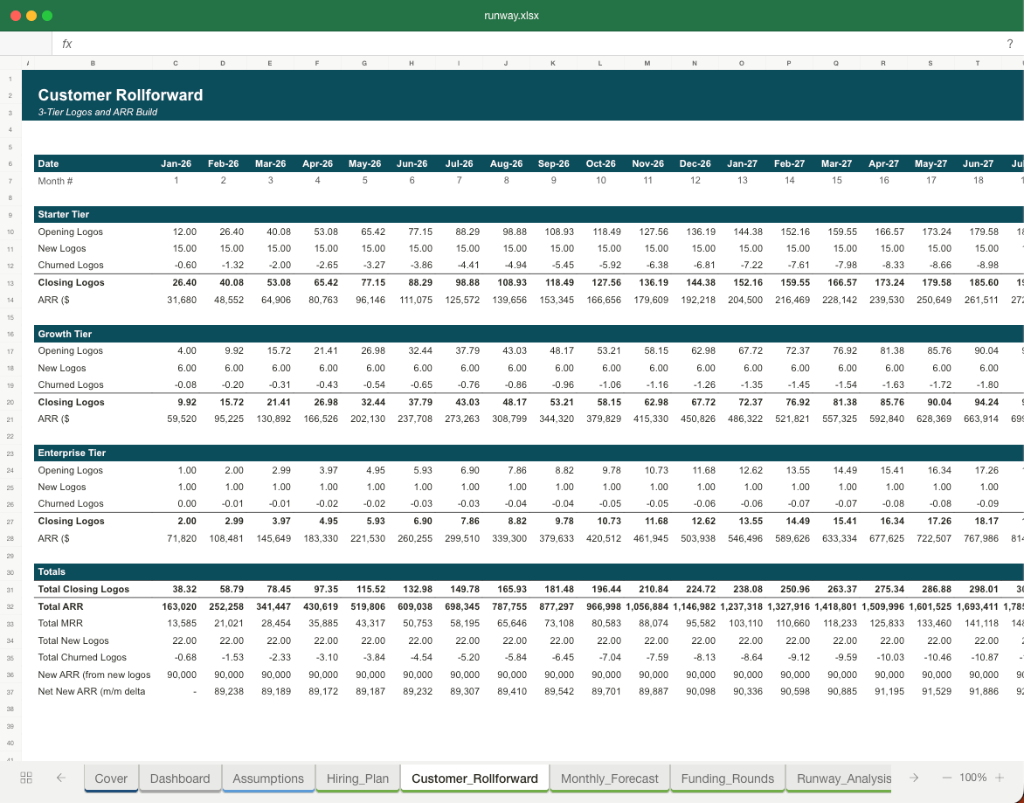
- Hospital Cohort Model - monthly new pilots, conversions, tier mix, churn; waterfall of ARR by cohort
- ARR Bridge - new ARR, expansion ARR, churned ARR, net new ARR
- P&L - Revenue, COGS, Gross Profit, S&M, R&D, G&A, EBITDA
- Headcount Plan - by function (Sales, Eng, CS, G&A), linked to opex
- Cash Flow & Runway - monthly burn, cash balance, months of runway
- KPI Summary - ARR, hospitals (pilot/contracted), blended ACV, net revenue retention, burn multiple
Frequently asked
Is the Vital financial model free?+
Yes. The Vital model is a free Excel (.xlsx) download with live formulas. Sign up with your email and the workbook is yours to keep, review, and edit.
What's included in the model?+
A 5-year monthly forecast with P&L, cash flow and runway, valuation (exit multiple plus a DCF cross-check), MOIC/IRR returns, and unit economics, with live formulas throughout.
How was this model built?+
It was built from Vital's pitch deck and publicly available information, then structured to investment-banking standards as a fully editable Excel model.
Can I change the assumptions?+
Yes. You can change assumptions and the live formulas will recalculate in the downloadable Excel model.
Have more financial modelling questions? Contact us

Created by ex-finance professionals
Hey, I’m Alex and I created Finamodel.
Over my years in the finance industry I kept building the same models over and over again. Same structure, same assumptions, different logo. So I started building frameworks to turn them into clean, reusable templates.
Every model here is one I’d actually use for a client, and I personally vet each one before it goes up.
I’m not an expert in every industry, but I’ve built enough models to know what belongs in one. And when something is completely foreign to me, I reach out to my network for experts to work on our models with us.
Having a template library on hand cuts a first build from hours to minutes.
Need help finding your model? You’ll find me in the Finamodel app!
Other Health-tech Startup Financial Models
Browse another startup in the same category.
98point6
B2B SaaS platform licensing an AI-powered virtual care technology stack to health systems, pivoted from running a direct-to-employer virtual clinic.
A-Champs
IoT-powered gamified training device (ROXs PRO) for sports/health professionals, evolving into a B2C smart coach app for families.

AccuRx
Patient-centred communication platform connecting everyone involved in a patient's care, starting with near-universal penetration in UK GP practices.

Aeris
Swiss-made premium air purifiers sold through DTC, retail, and dealer channels, with a recurring filter consumable attached to a connected mobile app.

Akido Labs
Akido Labs is a data-driven prevention platform that integrates siloed healthcare, municipal, and non-profit data to enable proactive outreach and case management for vulnerable populations (homeless, chronically ill, etc.).

Alloy
Telehealth + DTC subscription platform delivering menopause hormonal treatment (MHT) and holistic care to U.S. women 40+.

Astek Diagnostics
Point-of-care diagnostic device (Jiddu system) that confirms bacterial infections and antibiotic sensitivity in ~1 hour across four body fluid types (urine, CSF, effluent, blood).

Atom Limbs
Atom Limbs is building the first AI-powered, neural-controlled prosthetic arm sold direct-to-consumer on a subscription model.