 Yumi Nutrition Financial Model
Health-tech Startup Financials (Free Excel Download)
DTC gummy vitamin & supplement brand disrupting the UK dietary supplement market with tasty chewables sold online.



professionals from Deloitte
Used by professionals from






About this model
Yumi Nutrition is a UK DTC gummy-vitamin and supplement brand offering chewable alternatives to conventional pills. Its consumer proposition uses an accessible product format to attract buyers seeking routine wellness supplements without the friction of traditional tablets.
The business relies on online consumer acquisition and repeat supplement purchasing. Customer value depends on initial order conversion, subscription or repeat rate, average basket, product efficacy, retention, fulfilment reliability, and the cost of reaching consumers through digital channels.
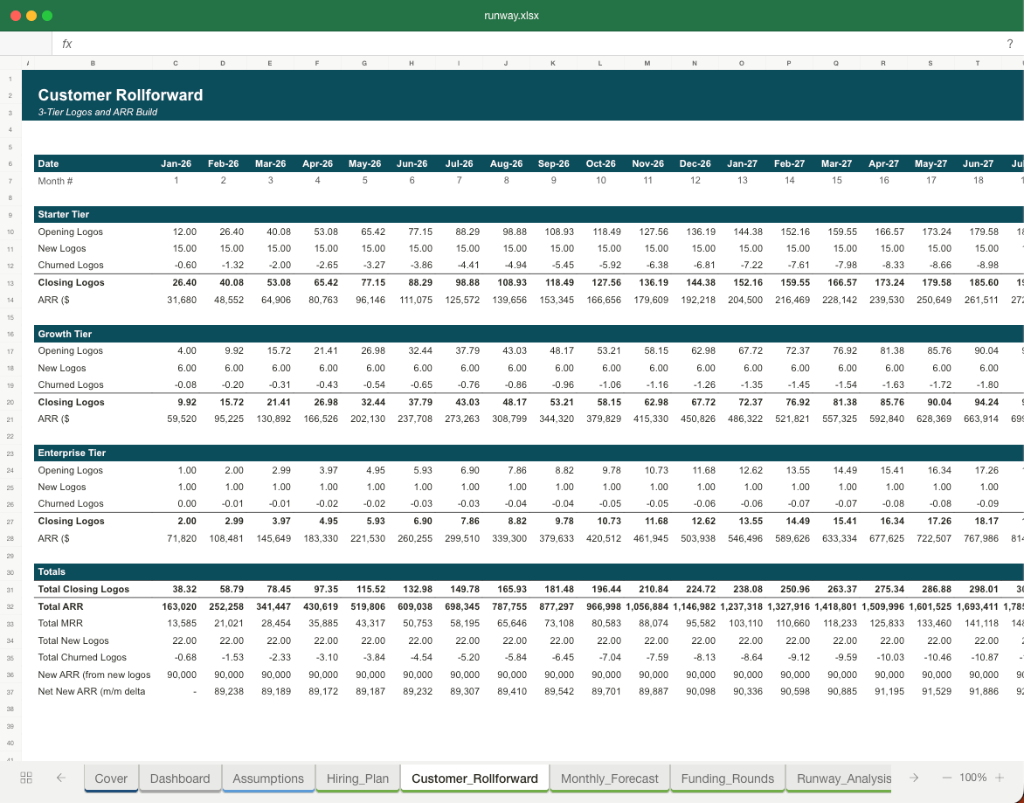
The model forecasts customers, orders, subscription or repeat rate, average basket, product margin, fulfilment, CAC, and churn. It includes manufacturing, packaging, inventory, marketing, gross margin, working capital, operating cash flow, cash burn, and runway.
A turnkey financial model
Live formulas, no hardcoded values
Outputs are driven by live formulas, so the workbook updates from its assumptions instead of relying on hardcoded results.
All assumptions in one tab
Inputs are clearly marked in the Assumptions tab and separated from calculations, making it clear what to change and what to leave intact.
Statements always balancing
For integrated-statement models, the balance sheet, cash flow, and supporting schedules tie through properly.
Distinct schedules for clarity
Debt, working capital, taxes, and cash flow can get messy quickly. We group calculations in clear schedules, not across disconnected tabs.
No hidden macros or external links
There are no unexplained external workbook links or macros to undermine auditability or portability.
Changes flow through the model
Update a key driver and see the impact carry through the forecast, financing, and return outputs. We never use hardcoded numbers in formulas.
About Yumi Nutrition
helloyumi.com
How to build a detailed financial model for Yumi Nutrition
A complete walkthrough of the business, drivers, and assumptions behind the downloadable Yumi Nutrition model - distilled from its pitch deck and publicly available information.
Product & value proposition
Current SKUs (all 60-gummy bottles): Sleep, Hair Skin & Nails, Multivitamin, Probiotic. Future pipeline: CBD gummies, Apple Cider Vinegar, Zinc, Vitamin D; plus powders, bars, drinks, merchandise. Value prop: better-tasting, easy-to-consume supplements vs. tasteless/hard-to-swallow incumbents; strong brand positioning for online channels.
Market
- Worldwide dietary supplement market: $278B.
- Worldwide market growth: 9.6% p.a..
- US market: £77.8B.
- UK addressable market (SAM): £1.4B.
- E-commerce supplement sales: $12.8B.
- Gummy format share of US market: 7.5% of $77B = ~$5.8B.
- 65% of UK adults have taken supplements in the past year; 45% of those daily.
Revenue model
- Primary: DTC e-commerce (own website) - direct bottle sales at £13.99 RRP.
- Secondary: Amazon, influencer marketing.
- Expansion: B2B wholesale into health stores, chain stores, other online stores and dropshippers.
- Pricing: Single bottle RRP £13.99; 60 gummies per bottle.
- No subscription, bundles, or tiered pricing mentioned in deck.
Traction & metrics
- Current monthly sales: £15k+.
- Business is already profitable at time of raise.
- 18-month target: £100k/month in sales.
- Founders have self-funded to this point.
Financial projections (5-year, from slide 15):
| Year | Turnover (£) | Costs (£) | Net Profit (£) |
|---|---|---|---|
| Y1 | 22K | 10K | 12K |
| Y2 | 419K | 363K | 56K |
| Y3 | 1.80M | 1.37M | 430K |
| Y4 | 4.46M | 3.54M | 920K |
| Y5 | 6.89M | 5.56M | 1.33M |
Note: Projections include 30% profit distributed to shareholders annually (added as cost). Y1 profit reinvested back into business.
Unit economics
All figures from slide 13:
- RRP per bottle: £13.99
- Cost per bottle (COGS): £1.77
- Co-Packing & Packaging: £0.30
- Shipping: £2.32
- Cost per new customer (CAC): £2.00
- Total variable cost per bottle (new customer): £1.77 + £0.30 + £2.32 + £2.00 = £6.39
- Acquisition profit per bottle (first order): £7.60
- Implied gross margin (ex-CAC): (£13.99 − £1.77 − £0.30 − £2.32) / £13.99 = ~68%
Competition / moat
Competitive quadrant (price vs. product variety) - Yumi positioned: high variety / mid-price.
Competitors mapped:
- Low price / high variety: Boots, Vitafusion
- Low price / low variety: (unnamed green logo brand)
- High price / low variety: Hairburst, Sugarbearhair
- High price / high variety: Olly, Yumi
Moat claims: strong brand identity, online-first scalability, taste differentiation. No patents, exclusive formulas, or proprietary tech mentioned.
Team & funding ask / use of funds
Team:
- Sebastien Vanderlinden - 7 years business dev & marketing; £600k+ revenue generated in previous role within ~1 year.
- Adam Barker - BSc Business & Finance, FinTech at Oxford; £250k business dev in one month; prior startup founder.
- Joshua Margetts - BSc Graphic Design, Young Enterprise competition winner; also a model (brand-fit relevance).
Funding ask: £100k SEIS-approved.
Use of funds:
- Marketing & Growth: 50% (£50k) - e-commerce scaling, Amazon, influencers, new markets.
- Inventory & Operations: 30% (£30k) - inventory build, warehouse upgrade, product line expansion.
- Admin & Staff: 20% (£20k) - marketing hire, admin costs.
Recommended financial model
- Archetype + why: DTC Consumer Goods P&L with channel split (DTC vs. B2B wholesale). Revenue is unit-driven (bottles sold), with clear COGS, fulfillment, and paid-marketing spend lines. Not a SaaS or marketplace - a physical product with inventory. A 3-statement model would be overkill at this stage; a detailed P&L + cash flow is appropriate.
- Forecast horizon & granularity: 5 years annual (matching deck projections), with Year 1–2 on monthly granularity to track cash against the £15k/month current run-rate and the £100k/month 18-month target.
- Key drivers & assumptions:
- Monthly revenue run-rate at start: £15k
- Revenue growth rate Y1→Y2: implied ~19x from £22k to £419k; heavy front-loading from £100k injection; model should derive organically from unit volume + price, not apply a flat % growth.
- ASP per bottle: £13.99
- COGS per bottle: £1.77
- Co-packing & packaging per bottle: £0.30
- Shipping per bottle: £2.32
- CAC (new customer): £2.00
- Gross margin (ex-CAC): ~68%
- Marketing spend as % of revenue: ~30–40% in Y1–Y2 scaling phase, declining to ~20% at maturity; consistent with 50% of £100k raise going to marketing
- Repeat purchase rate: 30–40% monthly repurchase; consumable product with strong reviews, but no data in deck
- SKU count growth: 4 current → 6–8 by Y2 as pipeline products launch
- B2B wholesale revenue: zero in Y1, ~10–15% of revenue from Y3 as US/B2B channel opens
- Shareholder profit distribution: 30% of net profit added as cost from Y2 onward
- Inventory build (working capital): ~4–6 weeks of forward cover; key cash drag post-raise
- Headcount: founder-only in Y1; 1–2 hires in Y2 from admin/staff budget
- FX (USD/GBP): 0.80 for US market revenue translation; US revenue from Y3
- Scenarios (Base / Bull / Bear - which variables flex):
- Base: £100k/month by month 18 as stated; repeat rate 35%; CAC holds at £2
- Bull: US channel opens in Y2; repeat rate 45%; CAC improves via organic/SEO
- Bear: UK growth slower (£50k/month by month 18); CAC rises to £5 as paid channels saturate; B2B delayed to Y4
- Required sheets / outputs:
- Assumptions - all drivers in one place with toggle for scenarios
- Revenue Build - monthly units sold × ASP, split by DTC/B2B/Amazon; new vs. returning customers
- P&L - gross profit, contribution margin, EBITDA, net profit; 5-year annual + Y1–Y2 monthly
- Cost Build - COGS, fulfillment, marketing spend, staff, admin, shareholder distribution
- Cash Flow - operating cash flow; working capital (inventory); capex (warehouse); £100k injection timing
- Unit Economics - per-bottle waterfall (RRP → gross profit → contribution after CAC)
- Dashboard - KPIs: monthly revenue, gross margin %, CAC, monthly burn/surplus vs. target
Frequently asked
Is the Yumi Nutrition financial model free?+
Yes. The Yumi Nutrition model is a free Excel (.xlsx) download with live formulas. Sign up with your email and the workbook is yours to keep, review, and edit.
What's included in the model?+
A 5-year monthly forecast with P&L, cash flow and runway, valuation (exit multiple plus a DCF cross-check), MOIC/IRR returns, and unit economics, with live formulas throughout.
How was this model built?+
It was built from Yumi Nutrition's pitch deck and publicly available information, then structured to investment-banking standards as a fully editable Excel model.
Can I change the assumptions?+
Yes. You can change assumptions and the live formulas will recalculate in the downloadable Excel model.
Have more financial modelling questions? Contact us

Created by ex-finance professionals
Hey, I’m Alex and I created Finamodel.
Over my years in the finance industry I kept building the same models over and over again. Same structure, same assumptions, different logo. So I started building frameworks to turn them into clean, reusable templates.
Every model here is one I’d actually use for a client, and I personally vet each one before it goes up.
I’m not an expert in every industry, but I’ve built enough models to know what belongs in one. And when something is completely foreign to me, I reach out to my network for experts to work on our models with us.
Having a template library on hand cuts a first build from hours to minutes.
Need help finding your model? You’ll find me in the Finamodel app!
Other Health-tech Startup Financial Models
Browse another startup in the same category.
98point6
B2B SaaS platform licensing an AI-powered virtual care technology stack to health systems, pivoted from running a direct-to-employer virtual clinic.
A-Champs
IoT-powered gamified training device (ROXs PRO) for sports/health professionals, evolving into a B2C smart coach app for families.

AccuRx
Patient-centred communication platform connecting everyone involved in a patient's care, starting with near-universal penetration in UK GP practices.

Aeris
Swiss-made premium air purifiers sold through DTC, retail, and dealer channels, with a recurring filter consumable attached to a connected mobile app.

Akido Labs
Akido Labs is a data-driven prevention platform that integrates siloed healthcare, municipal, and non-profit data to enable proactive outreach and case management for vulnerable populations (homeless, chronically ill, etc.).

Alloy
Telehealth + DTC subscription platform delivering menopause hormonal treatment (MHT) and holistic care to U.S. women 40+.

Astek Diagnostics
Point-of-care diagnostic device (Jiddu system) that confirms bacterial infections and antibiotic sensitivity in ~1 hour across four body fluid types (urine, CSF, effluent, blood).

Atom Limbs
Atom Limbs is building the first AI-powered, neural-controlled prosthetic arm sold direct-to-consumer on a subscription model.