 Marpipe Financial Model
Consumer/DTC Startup Financials (Free Excel Download)
SaaS design platform that connects ad creative production with performance data, enabling brands to test creative at scale and centralise creative learnings.



professionals from Deloitte
Used by professionals from






About this model
Marpipe is a SaaS design platform that connects advertising-creative production with performance data. It helps consumer brands and agencies test creative variants at scale, centralise learnings, and link visual decisions to measurable commercial outcomes.
The company sells recurring software to marketing teams seeking to reduce the cost and uncertainty of creative experimentation. Its early-stage deck described an $8 million raise, a bootstrapped MVP, and heavy engineering investment, making product adoption and sales execution more useful than implied mature-scale assumptions.
The model builds ARR from new customers, campaigns, platform modules, ACV, expansion, and churn. Data-processing cost, sales capacity, product investment, gross margin, and measured customer ROI drive retention, operating expenses, and cash runway.
A turnkey financial model
Live formulas, no hardcoded values
Outputs are driven by live formulas, so the workbook updates from its assumptions instead of relying on hardcoded results.
All assumptions in one tab
Inputs are clearly marked in the Assumptions tab and separated from calculations, making it clear what to change and what to leave intact.
Statements always balancing
For integrated-statement models, the balance sheet, cash flow, and supporting schedules tie through properly.
Distinct schedules for clarity
Debt, working capital, taxes, and cash flow can get messy quickly. We group calculations in clear schedules, not across disconnected tabs.
No hidden macros or external links
There are no unexplained external workbook links or macros to undermine auditability or portability.
Changes flow through the model
Update a key driver and see the impact carry through the forecast, financing, and return outputs. We never use hardcoded numbers in formulas.
About Marpipe
marpipe.com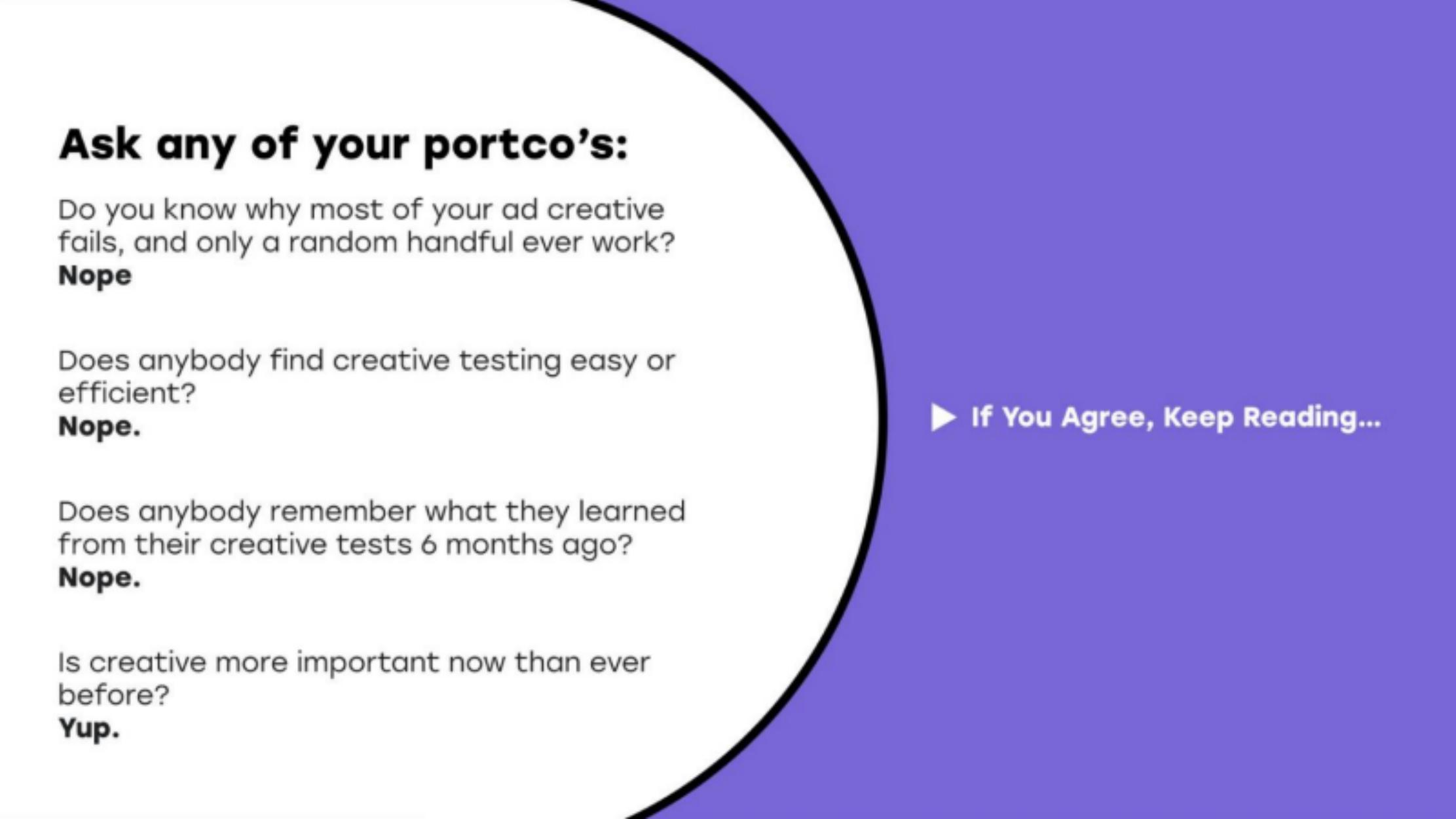
How to build a detailed financial model for Marpipe
A complete walkthrough of the business, drivers, and assumptions behind the downloadable Marpipe model - distilled from its pitch deck and publicly available information.
Product & value proposition
- Design platform that acts as connective tissue between creative teams and performance marketers.
- Introduces "Creative Component Data" - structured metadata on ad creative elements that ties design decisions to conversion outcomes.
- Enables systematic ad creative testing and iteration (replacing random trial-and-error).
- Brands centralise historical creative insights and own their creative data.
- Roadmap covers image → video → audio creative, feeding a centralised data layer and predictive analytics engine, culminating in "The First API For Creative".
Market
- Design Technology Industry: $162Bn, growing >20% in 2021 (Source: Forrester).
- Digital Display Ad Spend: $165Bn, growing >7.5% in 2021 (Source: Warc 2020).
- Creative Data Industry: described as a "New Market" with unknown TAM estimated at $10B+.
- Deck frames Marpipe's opportunity at the intersection of all three; the $10B+ "Creative Data Industry" TAM is their most relevant addressable market claim.
- SAM and SOM not broken out in deck.
Revenue model
- Not explicitly stated in deck. Implied B2B SaaS subscription based on platform positioning and team structure (dedicated CRO, Sales Manager, Customer Success Manager).
- Target customers: DTC brands and performance marketers; likely sold direct / inside sales.
Competition / moat
- Competitive landscape mapped across four categories:
- Seed-funded scanner/analytics apps: Pattern89, Junction, Datasine, CreativeX, Pudding.ai, Jove
- Auto-campaign management: AdEspresso, Qwaya, Madgicx, Adoptics, Outfox AI
- European entrants: Spirable, Smartly.io
- Tech-enabled managed services: New Engen, Vidmob, Omneky, TubeScience, Cohley
- Marpipe's claimed differentiation: none of the above address the creative workflow from the design side; Marpipe sits upstream at design creation.
- Moat thesis: proprietary Creative Component Data → accumulates with usage → creates a data flywheel that competitors cannot easily replicate.
- Internet privacy regulations (e.g. ATT/IDFA) cited as structural tailwind accelerating demand for creative-side signal.
Team & funding ask / use of funds
- Leadership:
- Dan Pantelo, CEO - previously ran DTC marketing & creative agency; bootstrapped initial MVP.
- Jeremy Bloom, CRO - previously Head of North America, Adobe Ad Cloud; led sales at TubeMogul (IPO).
- James Goldman, CTO - 2x startup CTO with 2 exits; CTO at Paintzen (acquired for $75m); VP Eng at PPG.
- Revenue team: COO, Sales Manager, Customer Success Manager.
- Eng/Product team: Head of Product, Head of Architecture, 4x Software Engineers, UX/UI Design Lead, Content Designer.
- Team stat: 40% women and minority representation.
- Funding ask: $8m.
- Use of funds:
- 80% Engineering / Product Team - rapid channel integrations (social, DSPs), video & audio engineering, data team.
- 20% Revenue Team.
Recommended financial model
- Archetype + why: B2B SaaS ARR model. Revenue is implied subscription; key metrics are ARR, MRR, customer count, ACV, churn, and NRR. The $8m raise is pre-revenue or very early revenue with heavy product investment (80% of spend to eng), which is classic SaaS seed structure. No marketplace or usage-based mechanics shown.
- Forecast horizon & granularity: 3 years (Year 1–3), monthly for Year 1, quarterly for Years 2–3. Matches seed/Series A investor expectations.
- Key drivers & assumptions:
| Driver | Value | Source |
|---|---|---|
| Funding raised | $8m | - |
| Headcount split (Eng/Product vs Revenue) | 80% / 20% | - |
| Total headcount at raise | ~15 people | - |
| CTO pedigree exit ($75m Paintzen) | qualitative only | - |
| TAM (Creative Data) | $10B+ | - |
| Design Tech market size | $162Bn growing >20% | - |
| Digital Ad Spend market size | $165Bn growing >7.5% | - |
| Starting ARR | - | Pre-revenue or very early; no traction slide shown |
| ACV / ASP | $12k–$36k/yr; mid-market DTC brand SaaS comps | Rationale: CRO from Adobe/TubeMogul enterprise background suggests $1k–$3k/mo per seat or per brand |
| Monthly new logo adds (Year 1) | 2–5/mo ramping; small team, direct sales | - |
| Gross margin | 70–75%; SaaS with data infra costs | - |
| Gross churn (annual) | 15–20% early-stage; no retention data in deck | - |
| CAC | $8k–$15k; direct outbound with senior CRO | - |
| Burn rate | ~$350k–$450k/mo post-raise (15-person team + infra) | based on headcount and SF/NY SaaS norms |
| Runway | ~18–24 months on $8m raise | - |
| Sales cycle | 30–60 days; SaaS for mid-market marketing teams | - |
- Scenarios (Base / Bull / Bear - which variables flex):
- Bear: slow enterprise sales cycle (90+ days), ACV $10k, churn 25%, eng delays on video/audio roadmap - runway tightens to 15 months.
- Base: ACV $18k, 3 logos/mo by month 6, churn 15%, roadmap on schedule - ~$1.5m ARR at end of Year 1.
- Bull: product-led motion emerges (API for Creative opens self-serve), ACV $24k, churn <10%, NRR >110% - $3–4m ARR end of Year 1.
- Required sheets / outputs:
- Assumptions & Controls (toggle Base/Bull/Bear)
- Revenue Build (customer cohort waterfall: new logos × ACV, expansion, churn → MRR/ARR)
- Headcount Plan (Eng/Product 80%, Revenue 20% of $8m; add hires by quarter)
- P&L (Revenue, COGS → Gross Profit, OpEx by department, EBITDA)
- Cash Flow & Runway (opening $8m cash, monthly burn, months of runway)
- Unit Economics Summary (CAC, LTV, LTV/CAC, payback period)
- KPI Dashboard (ARR, MRR, customers, NRR, burn, runway)
Frequently asked
Is the Marpipe financial model free?+
Yes. The Marpipe model is a free Excel (.xlsx) download with live formulas. Sign up with your email and the workbook is yours to keep, review, and edit.
What's included in the model?+
A 5-year monthly forecast with P&L, cash flow and runway, valuation (exit multiple plus a DCF cross-check), MOIC/IRR returns, and unit economics, with live formulas throughout.
How was this model built?+
It was built from Marpipe's pitch deck and publicly available information, then structured to investment-banking standards as a fully editable Excel model.
Can I change the assumptions?+
Yes. You can change assumptions and the live formulas will recalculate in the downloadable Excel model.
Have more financial modelling questions? Contact us

Created by ex-finance professionals
Hey, I’m Alex and I created Finamodel.
Over my years in the finance industry I kept building the same models over and over again. Same structure, same assumptions, different logo. So I started building frameworks to turn them into clean, reusable templates.
Every model here is one I’d actually use for a client, and I personally vet each one before it goes up.
I’m not an expert in every industry, but I’ve built enough models to know what belongs in one. And when something is completely foreign to me, I reach out to my network for experts to work on our models with us.
Having a template library on hand cuts a first build from hours to minutes.
Need help finding your model? You’ll find me in the Finamodel app!
Other Consumer/DTC Startup Financial Models
Browse another startup in the same category.
Accel Club
Accel Club acquires Amazon third-party (FBA) seller businesses at 3–4x EV/EBITDA and scales them through operational integration, then exits at higher consumer/D2C multiples.
Afrocenchix
D2C brand selling natural, vegan-certified hair-care products for afro and curly hair.

Amperity
Enterprise Customer Data Platform (CDP) that unifies first-, second-, and third-party customer data across siloed systems to power personalization, analytics, and marketing activation.

AnyRoad
Enterprise SaaS platform for managing, measuring, and optimising branded experiential marketing.
Attentive
B2B SMS / mobile marketing SaaS for e-commerce and retail brands.

Aura
All-in-one consumer "intelligent safety" subscription replacing fragmented point solutions for identity, device, WiFi, social, assets, and privacy protection.

Belgian Boys
Belgian-inspired premium specialty food brand selling cookies, refrigerated cheesecakes, frozen waffles/crepes, and snacks through US retail and DTC channels.
Bespoken Spirits
Technology company that replaces barrel aging with a proprietary ACTivation process to produce premium, customizable spirits in days rather than decades.


