OXOxwash Financial Model
Logistics/Mobility Startup Financials (Free Excel Download)
Tech-enabled B2B laundry service using ozone/ambient-temperature washing and eCargo bikes targeting SMEs in the UK [DECK]



professionals from Deloitte
Used by professionals from






About this model
Oxwash is a tech-enabled UK B2B laundry service using ozone washing and eCargo bikes. It targets SME customers with lower-energy, lower-emission laundry operations.
The model should translate accounts, laundry volume, and revenue per kilogram into sales. Facilities, labour, the eCargo fleet, and route density determine the cost of handling and delivering that volume.
Forecast operating costs and route density as the account base grows. This lets the plan test whether increasing laundry throughput improves the economics of a lower-energy service model. Show the role of ozone washing and eCargo bikes within the facilities and delivery-cost build for each SME account.
A turnkey financial model
Live formulas, no hardcoded values
Outputs are driven by live formulas, so the workbook updates from its assumptions instead of relying on hardcoded results.
All assumptions in one tab
Inputs are clearly marked in the Assumptions tab and separated from calculations, making it clear what to change and what to leave intact.
Statements always balancing
For integrated-statement models, the balance sheet, cash flow, and supporting schedules tie through properly.
Distinct schedules for clarity
Debt, working capital, taxes, and cash flow can get messy quickly. We group calculations in clear schedules, not across disconnected tabs.
No hidden macros or external links
There are no unexplained external workbook links or macros to undermine auditability or portability.
Changes flow through the model
Update a key driver and see the impact carry through the forecast, financing, and return outputs. We never use hardcoded numbers in formulas.
About Oxwash
oxwash.com
How to build a detailed financial model for Oxwash
A complete walkthrough of the business, drivers, and assumptions behind the downloadable Oxwash model - distilled from its pitch deck and publicly available information.
Product & value proposition
- Branded as "Clinically Clean. Space Age Laundry"
- Targets the SME segment sitting between consumer (home) and enterprise (large contract) laundry - described as "fastest growing segment" and currently underserved
- Differentiators:
- Ambient temperature (20°C) washing: 45% lower carbon, 3x garment longevity vs. hot wash
- Ozone sterilisation: 99% kill rate at ambient temp; oxidises detergent residue in wastewater
- eCargo bikes: 85% more efficient than road vehicles
- Microfibre filtration: >1M fibres filtered per wash
- Patent intent in three areas: drying, probiotic conditioner, microfibre filtration
- Localised hub model with automated logistics
Market
- UK laundry market: £2.5B
- Global laundry market: £42B
Revenue model
- B2B commercial laundry: SMEs pay per wash/kg (pick-up and delivery included)
- Key customer segments from logos shown: food delivery (Deliveroo), hospitality (Marriott), university/institutional (University of Oxford), events (Virgin London Marathon)
- Revenue unit: weight-based (kg per day is the operational metric used internally)
- Channels: Direct B2B sales; rider-based last-mile logistics
Traction & metrics
Operational KPIs (slide 6):
- Collection/delivery success rate: 99.8%
- On-time rate (15-min window): 86.4%
- Rider utilisation rate: 78.2%
- Daily throughput: ~300 kg/day
- Daily customer count: ~40–50 customers/day
Financial trajectory (slide 7 - bar chart, Revenue in £000s): Reading from chart image (approximate bar heights):
- 2018: Revenue ~£50k
- 2019: Revenue ~£200k
- 2020: Revenue ~£700k
- 2021: Revenue ~£1.7M
- 2022–2025: Bars significantly larger - likely projections given deck appears early stage
- 2022: Revenue ~£3.2M, EBITDA ~£200k
- 2023: Revenue ~£5.8M, EBITDA ~£1.8M
- 2024: Revenue ~£8.2M, EBITDA ~£3.5M
- 2025: Revenue ~£12M, EBITDA ~£6M
- EBITDA turns positive in projection years; 2018–2021 bars show minimal or negative EBITDA
Note: Deck does not clearly label which years are actuals vs. projections.
Unit economics
- Deck claims "High Margin / Unit Economics" as a model pillar but provides no specific numbers
- EBITDA margin implied by chart (2025P): ~£6M / £12M = 50% - treat with caution, likely management projection
Competition / moat
- Existing incumbents framed as "ineffective, geographically disparate and unsustainable with high error rates and low margins"
- Moat claimed via: proprietary technology (ozone, microfibre, probiotic conditioner), patent pipeline, sustainable brand positioning, and localised hub+logistics network
- No direct competitor named or benchmarked in the deck
Team & funding ask / use of funds
Team:
- Kyle C Grant - CEO; ex-NASA scientist, Oxford PhD
- Thomas de Wilton - COO; Oxford engineer with modular assembly/operations experience
- Aron Ping D'Souza - Chairman; PE fund manager, $10B AUM experience
Key advisors:
- Benjamin Legg - Ex-Google COO, Ola UK CEO, VP Sales Coca-Cola
- Srin Madipalli - Airbnb Head of Product, ex-CEO Accomable, Oxford MBA
- Daniel Channer - Ex-MD Finders Keepers, director Countrywide, WPP Fellow
Recommended financial model
- Archetype + why: B2B commercial laundry - volume-based P&L model with hub economics. Best structured as a unit-economics-up model: kg throughput per hub × revenue/kg → revenue; hub opex (riders, machinery, water, energy) → gross margin; then G&A and capex for hub expansion. Similar architecture to a DTC route-density/logistics P&L.
- Forecast horizon & granularity: Monthly for Years 1–2, quarterly for Years 3–5. 5-year horizon to show path to the 2025 projections shown in deck.
- Key drivers & assumptions:
| Driver | Value | Source |
|---|---|---|
| Daily kg throughput (current) | ~300 kg/day | - |
| Customers per day (current) | ~40–50 | - |
| Implied avg kg/customer | ~6–7.5 kg | - |
| Revenue per kg | - | ~£12–£15/kg is typical B2B laundry pricing in UK |
| Daily revenue run-rate | - | ~£3,600–£4,500/day at above rate |
| Rider utilisation | 78.2% | - |
| Collection/delivery success | 99.8% | - |
| On-time rate | 86.4% | - |
| Hub count | 1 (Oxford implied) | - |
| Hub expansion pace | 1 new hub/year in Years 2–5; enter new UK cities | |
| Revenue CAGR (implied to 2025) | ~£12M from ~£700k-£1.7M = high growth | - |
| EBITDA margin (2025P) | ~50% | treat with caution |
| Gross margin | 60–65% - consistent with laundry outsourcing where labour/water/energy = main COGS | |
| Rider cost per kg | £2–3/kg (eCargo bikes reduce per-unit cost vs. vans) | |
| Machine capex per hub | £150k–£300k - industrial washers + ozone systems | |
| Working capital | Minimal - B2B invoicing typically 30-day terms |
- Scenarios (Base / Bull / Bear - which variables flex):
- Base: Hub ramp as planned, revenue/kg at midpoint, rider utilisation stable at 78%
- Bull: Faster city expansion (2 hubs/year), B2B contract wins accelerate (hospitality/events), margin expansion as hub density grows
- Bear: Slower B2B sales cycle, lower revenue/kg due to competitive pressure, hub capex overruns, regulatory friction on eCargo access
- Required sheets / outputs:
- Assumptions dashboard (all drivers in one place)
- Hub build-out schedule (hub count × city × go-live date)
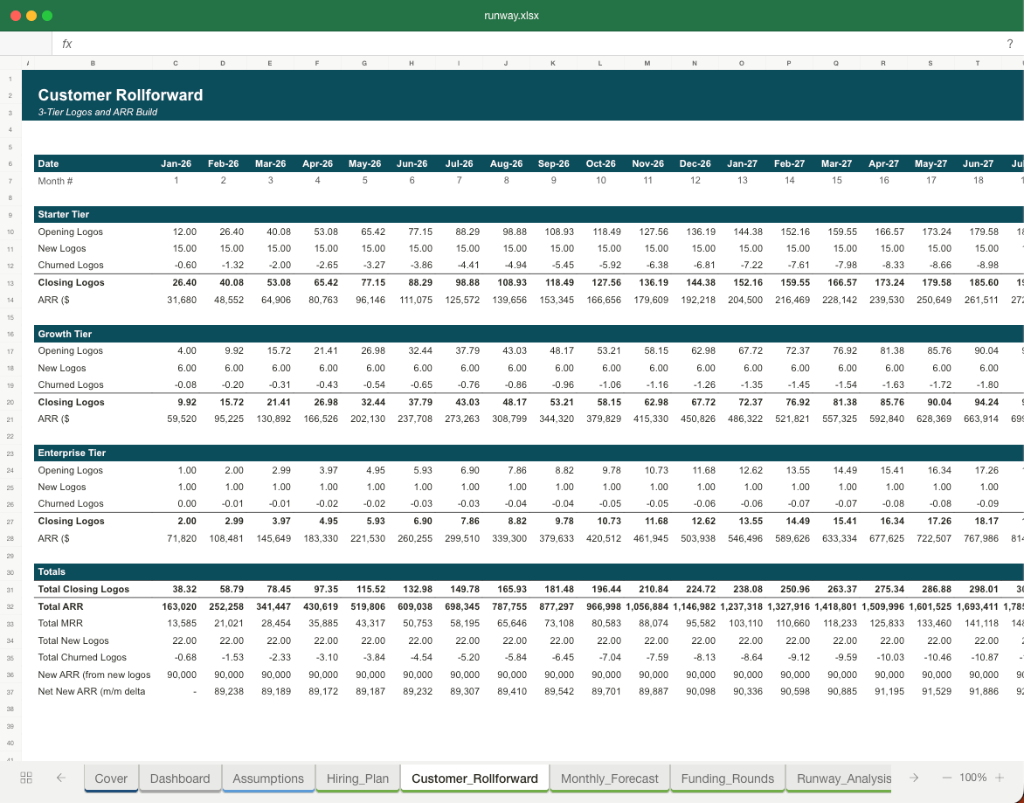
- Revenue model (kg/hub/day × hubs × rev/kg → monthly revenue)
- P&L (revenue, COGS by category, gross margin, opex, EBITDA)
- Capex schedule (hub setup, machinery, eCargo fleet)
- Simplified cash flow / runway (no full BS needed at this stage unless requested)
- KPI tracker (kg/day, customers/day, rider utilisation, on-time %)
- Scenario toggle
Frequently asked
Is the Oxwash financial model free?+
Yes. The Oxwash model is a free Excel (.xlsx) download with live formulas. Sign up with your email and the workbook is yours to keep, review, and edit.
What's included in the model?+
A 5-year monthly forecast with P&L, cash flow and runway, valuation (exit multiple plus a DCF cross-check), MOIC/IRR returns, and unit economics, with live formulas throughout.
How was this model built?+
It was built from Oxwash's pitch deck and publicly available information, then structured to investment-banking standards as a fully editable Excel model.
Can I change the assumptions?+
Yes. You can change assumptions and the live formulas will recalculate in the downloadable Excel model.
Have more financial modelling questions? Contact us

Created by ex-finance professionals
Hey, I’m Alex and I created Finamodel.
Over my years in the finance industry I kept building the same models over and over again. Same structure, same assumptions, different logo. So I started building frameworks to turn them into clean, reusable templates.
Every model here is one I’d actually use for a client, and I personally vet each one before it goes up.
I’m not an expert in every industry, but I’ve built enough models to know what belongs in one. And when something is completely foreign to me, I reach out to my network for experts to work on our models with us.
Having a template library on hand cuts a first build from hours to minutes.
Need help finding your model? You’ll find me in the Finamodel app!
Other Logistics/Mobility Startup Financial Models
Browse another startup in the same category.

BusRight
SaaS platform for K-12 school district transportation management - routing, real-time tracking, driver tablets, parent notifications.
Clean Kitchen Club
UK plant-based QSR brand operating eat-in, grab-and-go, and delivery formats across London, with plans for nationwide expansion.

Cloudsmith
Cloud-native software supply chain management platform - secure, managed package distribution for engineering teams.
Enron
Enron Communications ("ePower") is a wholly owned subsidiary of Enron Corp. pitching an application delivery platform built on a national Pure IP fiber optic network.
Hangry
Indonesia's first multi-brand virtual restaurant operator ("House of Winning Brands") running delivery-only F&B brands out of shared kitchen infrastructure.

Hologram
IoT cellular connectivity platform that abstracts SIM management, carrier selection, and device fleet operations into a single software layer.

HTEC
Technology services and product engineering firm providing outsourced R&D, product development, and engineering delivery to corporates, scaleups, and global enterprises.
Liefergrün
Sustainable, customer-oriented last-mile delivery solution for e-commerce, using cargo bikes and e-vans with microhub infrastructure.