SpaceX Financial Model
Logistics/Mobility Startup Financials (Free Excel Download)
SpaceX is developing the BFR (Big Falcon Rocket) to make humanity a multiplanet species - starting with Mars colonisation, with near-term revenue from satellite launches, ISS resupply, and eventually Earth-to-Earth transport.



professionals from Deloitte
Used by professionals from






About this model
SpaceX develops the BFR to support multiplanet ambitions while generating nearer-term launch and space-services revenue. Satellite launches, ISS resupply, and future Earth-to-Earth transport underpin a capital-intensive aerospace platform.
The model should build launches and revenue per mission by service, separating satellite launches, ISS resupply, and other space services. Backlog should determine the timing and visibility of future missions.
Forecast launch cost, R&D, capex, and financing alongside mission revenue. This frames how nearer-term space-services activity can support an aerospace platform pursuing BFR development and multiplanet ambitions. It should keep satellite launches, ISS resupply, and future Earth-to-Earth transport visible as distinct revenue opportunities with different mission profiles.
A turnkey financial model
Live formulas, no hardcoded values
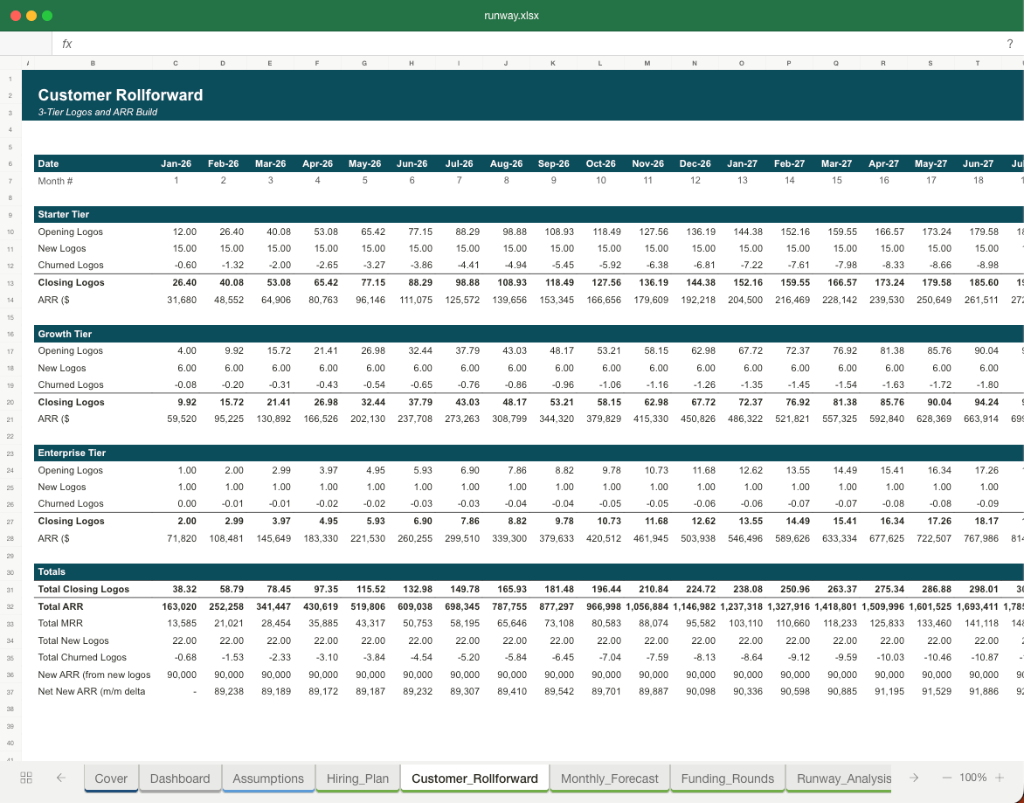
Outputs are driven by live formulas, so the workbook updates from its assumptions instead of relying on hardcoded results.
All assumptions in one tab
Inputs are clearly marked in the Assumptions tab and separated from calculations, making it clear what to change and what to leave intact.
Statements always balancing
For integrated-statement models, the balance sheet, cash flow, and supporting schedules tie through properly.
Distinct schedules for clarity
Debt, working capital, taxes, and cash flow can get messy quickly. We group calculations in clear schedules, not across disconnected tabs.
No hidden macros or external links
There are no unexplained external workbook links or macros to undermine auditability or portability.
Changes flow through the model
Update a key driver and see the impact carry through the forecast, financing, and return outputs. We never use hardcoded numbers in formulas.
About SpaceX
spacex.com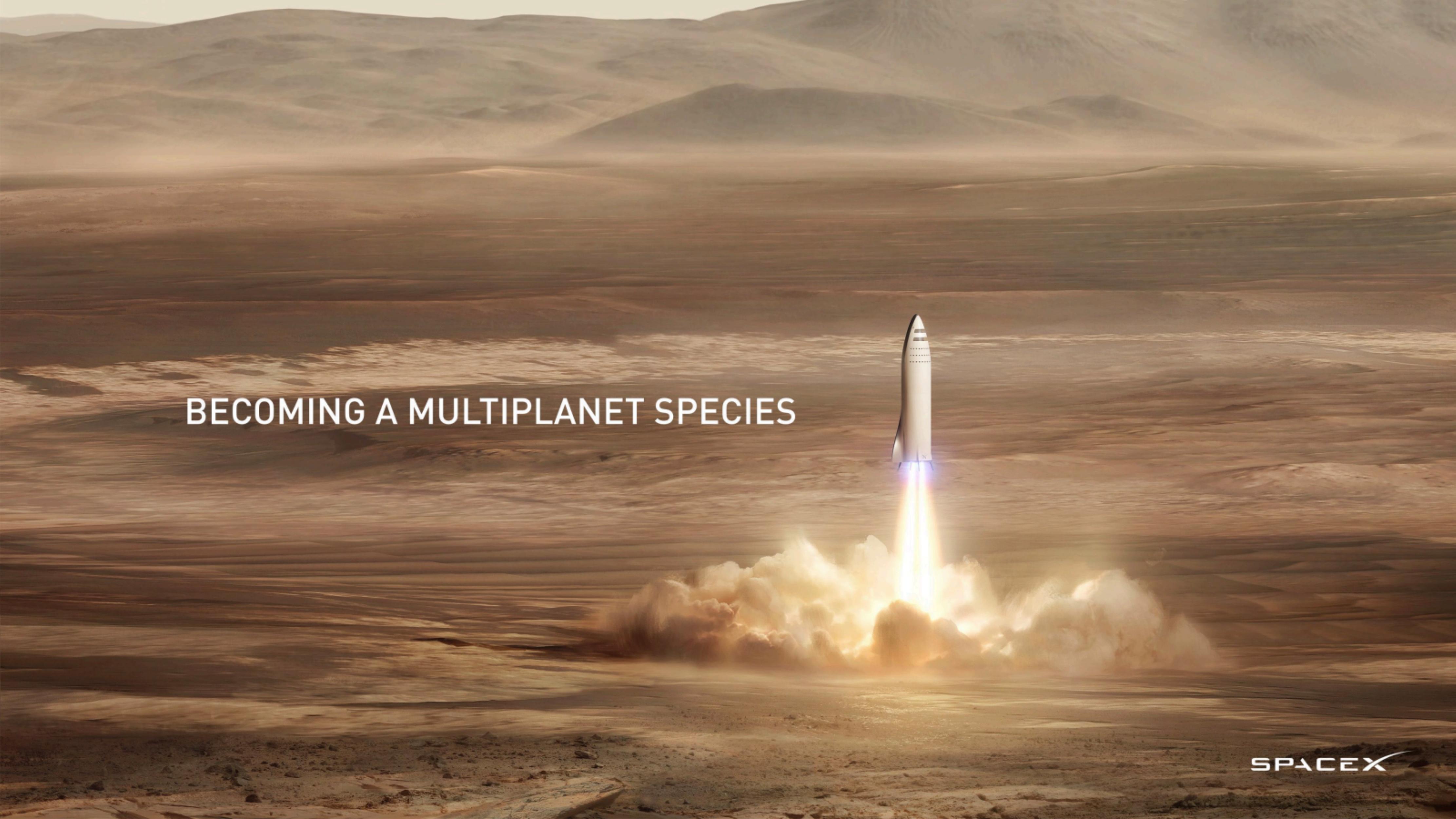
How to build a detailed financial model for SpaceX
A complete walkthrough of the business, drivers, and assumptions behind the downloadable SpaceX model - distilled from its pitch deck and publicly available information.
Product & value proposition
- Falcon 9 (partially reusable): 22.8t LEO payload; 18 successful booster landings as of 10/15/2017.
- Falcon Heavy (partially reusable): 54.4t LEO payload.
- BFR (fully reusable, under development): 150t LEO payload, 106m tall, 9m body diameter, booster thrust 52,700 kN. Designed to replace Falcon 9, Falcon Heavy, and Dragon, consolidating all revenue into a single vehicle platform.
- BFR ship: 48m length, 85t dry mass, 1,100t propellant, max 150t ascent payload / 50t return payload, pressurised volume 825m³.
- Raptor engines: 6 per ship (2 sea-level, 4 vacuum), 1,700–1,900 kN thrust each, 250 bar chamber pressure.
- Key moat: full reusability → lowest marginal cost per launch in the market; propulsive precision landing eliminates landing legs.
- Secondary use cases: ISS resupply, satellite deployment, lunar surface missions, Earth-to-Earth transport (< 30 min most long-haul routes).
Market
- No explicit TAM/SAM/SOM figures in deck.
- Competitive context provided via payload-to-LEO comparison: SpaceX competes with Ariane 5 (20t), Atlas V (18.8t), Proton M (22t), Delta IV Heavy (28.3t), Saturn V (135t). BFR at 150t is positioned as superior to all.
- Launch cost positioning: BFR claimed to have lowest marginal cost per launch of any vehicle shown, including its own Falcon family. No absolute dollar figures given.
- Earth-to-Earth transport framed as a new market ("most long distance trips completed in less than half an hour"). No market size stated.
Revenue model
- Commercial satellite launches: Falcon 9 / Falcon Heavy / (future) BFR - per-launch contracts with satellite operators.
- Government/ISS resupply: NASA CRS contracts (ISS section slide 25); implied ongoing.
- Crew transport: BFR Mars transit configuration seats 40 cabins - implies future ticket revenue for Mars/Moon missions.
- Earth-to-Earth transport: BFR P2P transport pitched as future revenue stream.
- Satellite deployment: BFR capable of deploying large satellite constellations.
- No pricing, contract values, backlog figures, or revenue breakdown disclosed in deck.
Traction & metrics
- Launch rate: 2 (2012), 3 (2013), 6 (2014), 7 (2015), 8 (2016), 15 actual / 20 projected (2017), 30 projected (2018)
- 18 successful Falcon 9 booster landings as of 10/15/2017
- Engine testing: over 1,200 seconds of firing across 42 main engine tests; longest test 100s; operates at up to 200 atmospheres
- Deep cryo LOX tank: pressure tested to 2.3 atmospheres; volume 1,000m³; holds 1,200 tons of liquid oxygen
- No revenue, ARR, backlog, or customer count figures in deck.
Unit economics
- No explicit CAC, LTV, gross margin, or payback data in deck.
- Cost positioning only: BFR described as having the lowest marginal cost per launch accounting for reusability; no absolute cost figures given.
- Implied COGS driver: propellant cost (CH₄ + O₂) is the primary variable cost per reusable launch; all hardware is reused.
Competition / moat
- Competitors shown: Falcon 1, India GSLV, Antares, Soyuz 2-1B, Atlas V 551, Japan H-IIB, Ariane 5, Proton M/Breeze M, China LM-5, Delta IV Heavy, Saturn V.
- BFR moat: full reusability (all others are expendable or partially reusable) + superior payload capacity (150t vs next-best Saturn V at 135t, but Saturn V is retired).
- Precision landing technology (18 successful landings) as demonstrated operational advantage.
- In-situ resource utilisation (ISRU) on Mars: propellant production from local H₂O + CO₂ → CH₄ + O₂, enabling return trips without Earth resupply. Structural barrier to any competitor attempting Mars operations.
Team & funding ask / use of funds
- Elon Musk cited as CEO and Lead Designer.
- No other team members named. No funding ask, round size, valuation, or use of funds stated anywhere in deck.
Recommended financial model
- Archetype + why: Launch services revenue model (volume × price per launch, by vehicle) + long-horizon R&D capex schedule. This is an operating company with a clear near-term revenue engine (Falcon 9/Heavy commercial + government launches) and a speculative long-term platform (BFR). The appropriate model is a multi-segment launch services P&L with a parallel BFR development capex burn schedule. Not a SaaS or marketplace model; not M&A or SPAC.
- Forecast horizon & granularity: 2017–2030; annual. Near-term (2017–2022) monthly optional for cash burn detail. 2022–2030 is the BFR operational and Mars mission phase.
- Key drivers & assumptions:
- Falcon 9 launches per year: 15 actual in 2017, 20 target 2017, 30 target 2018; growth rate post-2018
- Falcon 9 list price per launch
- Falcon Heavy launches per year
- Falcon Heavy price per launch
- BFR development capex
- BFR first cargo Mars mission: 2022
- BFR first crewed Mars mission: 2024
- BFR launch price
- Reuse factor / reflight cadence
- Government contract revenue (NASA CRS/crew)
- Earth-to-Earth transport revenue
- ISRU Mars propellant production cost
- Headcount / opex growth
- Scenarios (Base / Bull / Bear - which variables flex):
- Base: Launch rate grows per deck trajectory (30 in 2018); BFR first flight 2021–2022; Mars cargo 2024–2025 (1–2 year slip from deck); Earth-to-Earth remains R&D.
- Bull: BFR operational on schedule (2022 cargo); launch cadence exceeds 30/year; government mega-contracts for BFR; Earth-to-Earth commercialised post-2028.
- Bear: BFR delayed to 2025+; Falcon 9 market share eroded by Ariane 6 / Vulcan / New Glenn; cost overruns on BFR development; Mars missions pushed to 2030+.
- Primary flex variables: BFR development timeline, Falcon 9 launch cadence, BFR per-launch price, reuse cycle time, government contract renewals.
- Required sheets / outputs:
- Assumptions - all drivers above with / tags and scenario toggles
- Launch Volume - launches per year by vehicle (F9, FH, BFR cargo, BFR crew, BFR P2P)
- Revenue - launches × price per vehicle type; separate government vs commercial
- BFR Capex Schedule - development spend by phase (engine testing → full vehicle → Mars infrastructure)
- P&L - revenue, COGS (propellant + ops), gross profit, R&D/capex, EBITDA
- Cash Flow / Runway - especially pre-BFR revenue: when does BFR capex peak vs Falcon cash generation?
- Sensitivity Table - BFR price × launch cadence on EBITDA; BFR delay × capex on cash runway
- Dashboard - launch rate chart (extend slide 7 trajectory), revenue by segment, cumulative capex vs revenue
Frequently asked
Is the SpaceX financial model free?+
Yes. The SpaceX model is a free Excel (.xlsx) download with live formulas. Sign up with your email and the workbook is yours to keep, review, and edit.
What's included in the model?+
A 5-year monthly forecast with P&L, cash flow and runway, valuation (exit multiple plus a DCF cross-check), MOIC/IRR returns, and unit economics, with live formulas throughout.
How was this model built?+
It was built from SpaceX's pitch deck and publicly available information, then structured to investment-banking standards as a fully editable Excel model.
Can I change the assumptions?+
Yes. You can change assumptions and the live formulas will recalculate in the downloadable Excel model.
Have more financial modelling questions? Contact us

Created by ex-finance professionals
Hey, I’m Alex and I created Finamodel.
Over my years in the finance industry I kept building the same models over and over again. Same structure, same assumptions, different logo. So I started building frameworks to turn them into clean, reusable templates.
Every model here is one I’d actually use for a client, and I personally vet each one before it goes up.
I’m not an expert in every industry, but I’ve built enough models to know what belongs in one. And when something is completely foreign to me, I reach out to my network for experts to work on our models with us.
Having a template library on hand cuts a first build from hours to minutes.
Need help finding your model? You’ll find me in the Finamodel app!
Other Logistics/Mobility Startup Financial Models
Browse another startup in the same category.

BusRight
SaaS platform for K-12 school district transportation management - routing, real-time tracking, driver tablets, parent notifications.
Clean Kitchen Club
UK plant-based QSR brand operating eat-in, grab-and-go, and delivery formats across London, with plans for nationwide expansion.

Cloudsmith
Cloud-native software supply chain management platform - secure, managed package distribution for engineering teams.
Enron
Enron Communications ("ePower") is a wholly owned subsidiary of Enron Corp. pitching an application delivery platform built on a national Pure IP fiber optic network.
Hangry
Indonesia's first multi-brand virtual restaurant operator ("House of Winning Brands") running delivery-only F&B brands out of shared kitchen infrastructure.

Hologram
IoT cellular connectivity platform that abstracts SIM management, carrier selection, and device fleet operations into a single software layer.

HTEC
Technology services and product engineering firm providing outsourced R&D, product development, and engineering delivery to corporates, scaleups, and global enterprises.
Liefergrün
Sustainable, customer-oriented last-mile delivery solution for e-commerce, using cargo bikes and e-vans with microhub infrastructure.